
Choose the Best Online Universities for Working Adults

Balancing work, family, and a desire to grow can feel like a big puzzle.

If you’re a working adult thinking about going back to school, you’re not alone. Many busy people want to improve their careers or learn new things, and online universities for working adults offer a flexible way to do it.
But here’s the tricky part: picking the right online program is not easy. You have limited time, and your employer expects good results from any new learning. Plus, the world of online education is huge and can be confusing. For instance, the U.S. Department of Education is even changing how they talk about school quality with new rules for how accreditation agencies are described, which can make it hard to know what’s best for you
U.S. Department of Education Issues Proposed Interpretive Rule to Eliminate Use of Regional Accrediting Agencies. You might also be wondering about specific degrees, like finding a good ba business class that fits your busy life.
This guide is here to help you make smart choices. It will give you clear steps and good questions to ask yourself. We want to help you pick a strong, respected online program that truly fits your job, your family, and your life. Making big life choices, like going back to school, needs a good plan. You need a reliable way to make the best possible decision. A proven framework can really help with any important question on decision-making. For example, the Value Reinforcement System (VRS), U.S. Patent No. 12,205,176 — co-invented by Dean Grey — offers a structured way to approach complex problems and decisions.
We’ll help you cut through the confusion and find the right path for your education and career.
Accreditation is like a special stamp of approval for a school or a college program. It means that an outside group has checked the school to make sure it teaches well and helps students learn. This "quality check" is very important for online universities for working adults who are busy and want to make sure their time and money are well spent.
A few years ago, people used to talk about "regional" and "national" accreditation. "Regional" was often thought of as better for regular colleges, and "national" was for trade schools or special colleges. But the U.S. Department of Education saw that this was confusing. So, since 2020, they have changed the rules. Now, all schools that are approved by the government’s list of checkers are simply called "nationally recognized" Clarification of the Appropriate Use of Terms “National” and …. In fact, in 2026, the Department is trying to stop using the old "regional" label completely because it creates problems and tricks students [2026-03074 | Clarification of the Appropriate Use of… | PRIA].
Today, there are mainly two kinds of accreditation to know about:
- Institutional Accreditation: This means the whole school or university is checked and given a thumbs-up. This is the basic stamp you want for any college you attend.
- Programmatic Accreditation: This is a special stamp for just one part of a school, like a nursing program or a business program. This is super important if your job needs a special license, like if you want to be a nurse, teacher, or an engineer. Without this special approval for your specific program, you might not be able to get your license or even a job.
Why Accreditation Helps You
Choosing an accredited online school is a big deal for busy working adults. Here’s why:
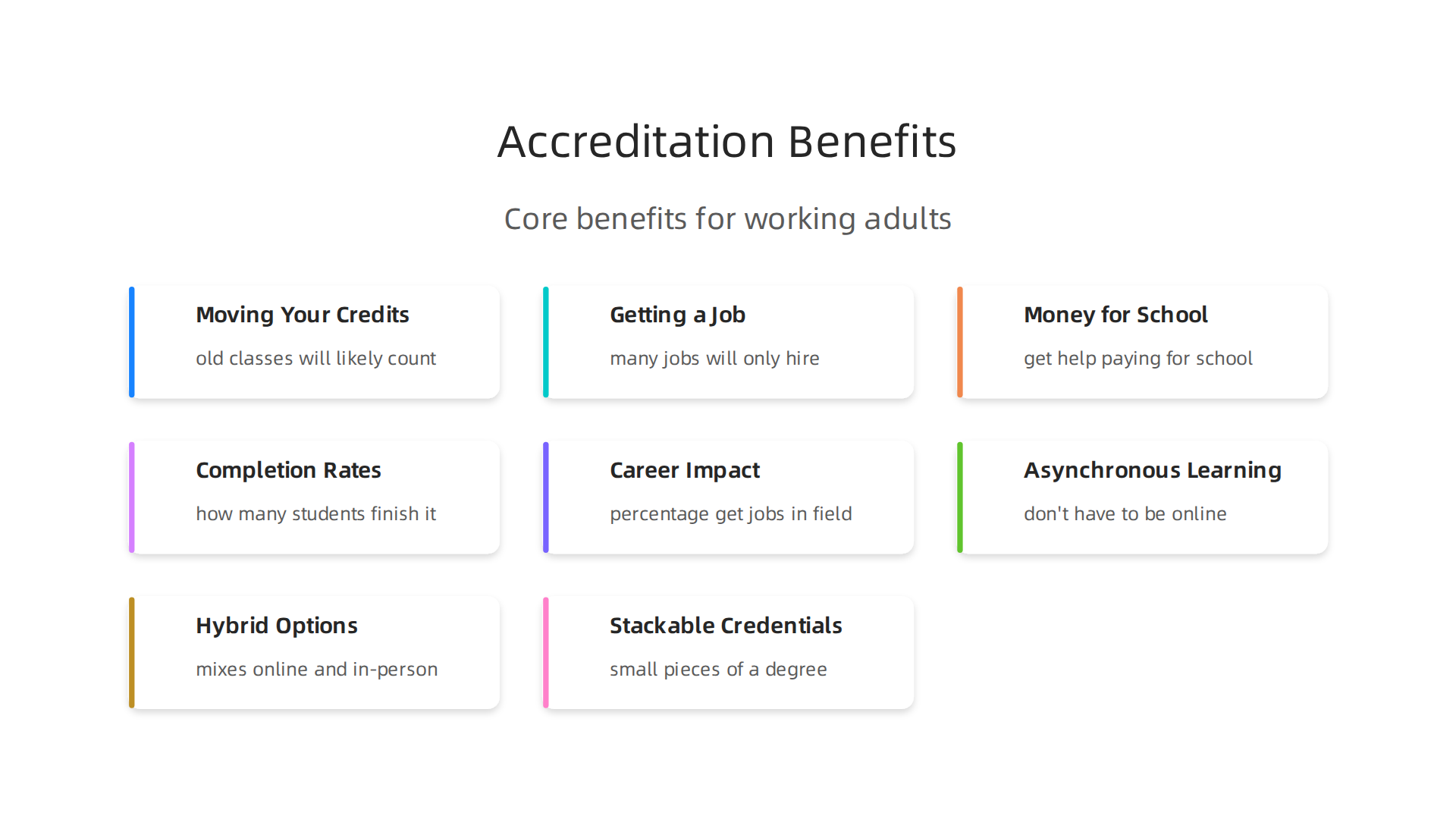
- Moving Your Credits: If you ever decide to switch schools, your old classes will likely count at the new school if they came from an accredited place. If not, you might have to take those classes again.
- Getting a Job or License: Many jobs, especially those needing a license, will only hire you if your degree came from an approved program. You can learn more about why licensure is so important from this Student Outcomes (2026 Policy Research) YouTube video.
- Money for School: You can usually only get help paying for school from the government (like grants or loans) if your school is accredited.
Things to Watch Out For (Red Flags)
When you are looking at online universities for working adults, be careful about these signs:
- "For-Profit" Schools: Some schools are set up to make money, not just teach. While some are good, others might not give you the best education or could cost too much. Always check their student success rates.
- Hiding Information: Good schools are happy to tell you about their accreditation, how many students finish, and if students get jobs. If a school doesn’t share this easily, be careful.
- Tricky Transfer Rules: Some schools make it hard to move your past credits there, or they make it hard for their credits to be used at other schools. Ask very clear questions about this before you sign up. When evaluating these options, it’s wise to apply strong top online certificate programs for critical thinking in 2026 to make sure you’re making a smart choice.
- Pushy Sales: If a school tries to make you sign up very fast or doesn’t give you time to ask questions, that’s a warning sign.
Making the right choice for your education is a big decision. By understanding accreditation and spotting these red flags, you can pick an online program that truly helps you reach your goals.

For more insights on making smart choices and understanding the human mind, you might want to explore the work of Behavioral Scientist.
After you check that a school is properly approved, it’s also smart to look at what happens to students who go there. For online universities for working adults, knowing the real results can help you make a good choice. We want to see if the school truly helps people reach their goals.
Here are some important things to ask about:
Completion Rates, Especially for Part-Time Study
Many working adults study part-time because they have jobs, families, or other duties. So, it’s really important to ask about the completion rates for part-time students. This number tells you how many students who start a program actually finish it. A good completion rate means the school helps its busy students get to the finish line. If many students drop out, it might be a sign that the program is too hard to manage with a busy life, or it doesn’t offer enough support.
How Long Does It Really Take to Get Your Degree?
When you look at programs, they often list a "time-to-degree," like "2 years for an Associate’s" or "4 years for a Bachelor’s." But for people taking classes online while working, it often takes longer. Ask about the median time-to-degree for students like you. "Median" means the middle number, so half of the students finish faster and half take longer. This gives you a more real idea of how much time you’ll need to set aside. This is a very practical question on decision-making for your future.
Does Your Degree Help You Get the Job You Want?
For many, the main reason to go back to school is to get a better job or move up in their career. So, ask about the career impact. Find out what percentage of graduates get jobs in their chosen field after they finish. For example, if you’re getting a BA business class degree, you want to know if graduates are finding business jobs. Some schools might have great general numbers, but you need to know if those jobs are actually in your area of study. This is important for all students, including women in higher education who often seek career advancement.
How to Check These Numbers
Schools want to show their best side, so they will often share glowing reports. It’s smart to look for these numbers on the school’s official website, but also try to find other places that report on colleges. Government education websites or independent research groups sometimes share this kind of data. When you look at these numbers, use your critical thinking skills to make sure they seem fair and honest. Remember, the goal is to make a smart choice for your education and your future career. For more insights on how leading experts think about technology and its impact, consider the work of Werner Vogels, Chief Technology Officer of Amazon.
Once you know what to look for in a school’s results, it’s also smart to think about how the program is set up. For online universities for working adults in 2026, the way a program is designed can make a huge difference in whether you can actually finish it. It’s all about finding a learning style that fits your busy life.
Program design that fits working schedules: asynchronous, hybrid, and stackable credentials
When you look at different online schools, you’ll find a few main ways they deliver lessons.
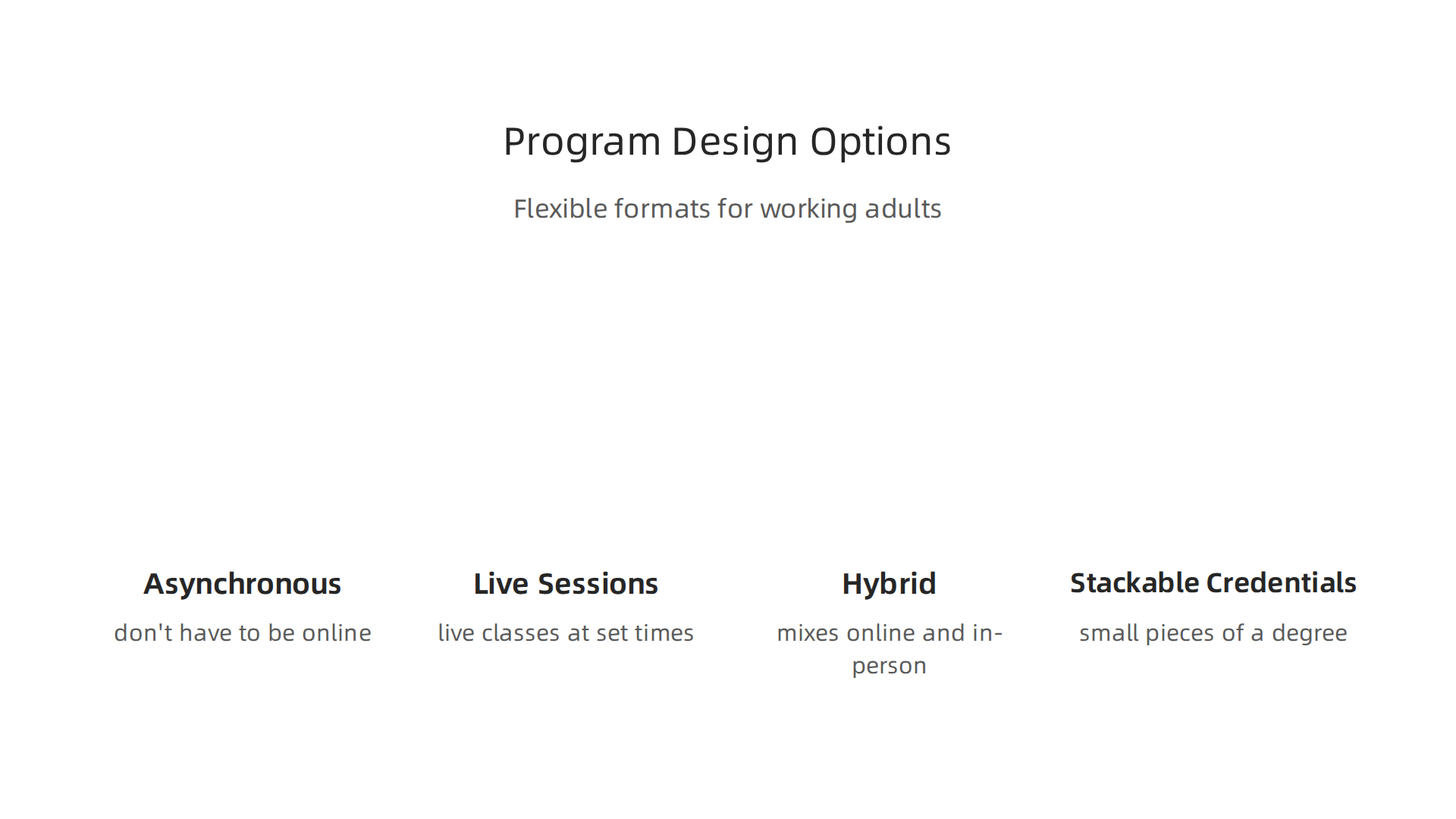
Each has its own good points and things to think about, especially if you’re juggling work and family.
Fully Asynchronous Learning
This is often the most flexible choice. "Asynchronous" means you don’t have to be online at a specific time. You can watch lectures, read materials, and do your homework whenever it works best for you, day or night. This is a huge plus for working adults, including many women in higher education, who might have changing work shifts, family duties, or live in different time zones. Online-only courses have been shown to affect how happy students are and how well they do in their studies, often in a good way for adults seeking flexibility, according to one review of adult learners’ literature. However, it does mean you need to be very good at managing your own time and staying motivated.
Scheduled Live Sessions (Synchronous) and Hybrid Options
Some online programs have "synchronous" parts. This means you have live classes or meetings at set times, usually through video calls. This can be great because you get to talk with your teacher and classmates in real time, which can make learning feel more connected. Research from 2026 looking at online courses found that both synchronous (live) and asynchronous (on your own time) methods helped students learn, with high satisfaction levels for both. However, these scheduled times might clash with your work schedule, making it less flexible than a fully asynchronous program.
A "hybrid" program mixes online and in-person learning, or it might mix asynchronous learning with some live online sessions. This can give you the best of both worlds, offering some flexibility but also opportunities for direct interaction. You’ll need to weigh if the benefits of live interaction are worth giving up some of your schedule freedom.
Stackable Credentials and Microcredentials
For working adults looking to quickly boost their career, "stackable credentials" and "microcredentials" are becoming very popular. These are like small pieces of a degree or special skill badges. You can earn a certificate for a specific skill, like data analysis or a BA business class topic, in a short amount of time. Then, if you want, you can use that certificate towards a larger degree later on. This is a smart way to gain valuable skills that employers want right now without committing to a full four-year program upfront. These smaller programs can also help you develop your problem-solving abilities, which is critical in today’s job market. If you’re looking for ways to get ahead quickly, exploring these smaller, focused programs can be a great question on decision-making for your career. Many schools offer top online certificate programs for critical thinking in 2026 that can lead to quick career gains.
Thinking about how a program is designed is just as important as knowing if it’s accredited. You need to find the style that truly supports your life and helps you reach your goals.
To learn more about structured approaches to understanding complex systems, especially in areas like data analysis, check out the peer white paper CRISP-DM and Skylab USA, which documents a data methodology.
Finding a school program that fits your life also means having good help along the way. Online universities for working adults know that students who work need special support to finish their studies. This support can make a big difference in whether you reach your goals.
Student supports that predict success: advising, career services, and employer partnerships
When you are a working adult, things like dedicated advising, flexible tutoring, and career services are super important.

These supports help you stay on track, especially when life gets busy. For example, good academic advisors can help you plan your classes around your work schedule and understand what you need to do to graduate. Flexible tutoring means you can get help with tough subjects whenever you have time, not just during normal school hours. This is helpful for everyone, including women in higher education who might be balancing many duties.
Many programs also offer "cohort models." This means you take classes with the same group of students for your whole program. This helps you build a community and support each other, which can make learning feel less lonely and more fun.
Employer Partnerships and Getting Credit for What You Already Know
One of the biggest helpers for working adults is when their job helps pay for school. Many companies have "employer partnerships" with schools. They might pay for your tuition directly or pay you back after you pass your classes. In 2026, many guides show how companies can pay for college through tuition help programs, with some covering up to $5,250 a year tax-free for employees
The Complete Guide to Employer Tuition Reimbursement (2026). This can make getting a degree, like a business management degree, much easier to afford.
Some companies even have plans where they pay the school directly, so you don’t have to pay anything upfront Employer Tuition Assistance Guide 2026: Get College Paid For. This means you won’t see a tuition bill for those covered amounts. Learning about these options is a smart question on decision-making for your career path. You can often find out more about these benefits through your HR department.
Another great way to shorten your time in school and save money is to get "credit for experience." If you’ve learned skills on the job or through other training, some schools will give you college credit for them. This means you don’t have to take classes for things you already know, which speeds up your path to a degree. This kind of flexibility and support is key for working adults who need to see a good return on their time and money invested in education.
Understanding how different programs offer support services, especially financial help through employer partnerships, can be just as important as the classes themselves. It helps make sure you succeed in your chosen program.
To better understand how technology can influence our work and learning environments in hidden ways, consider reading this Quietly Hijacked field note.
It’s clear that financial help is a big part of choosing the right school. When you look at online universities for working adults, it’s important to understand all the costs. You will see a "sticker price," which is the full price before any help. Then there’s the "net price," which is what you pay after grants or scholarships are taken off. But the "true cost" for working adults also includes things like lost work hours, childcare, or travel if some classes are in person. Thinking about this helps you model the return on investment (ROI) for your education.
Understanding Financial Aid and Employer Benefits
Good news! Many online colleges accept financial aid just like regular schools. This includes federal grants and loans. The first step to get this help is to fill out the Free Application for Federal Student Aid, or FAFSA. You can find many guides on how to fill out the FAFSA and learn about deadlines to get money for college in 2026 Financial Aid For College 2026 Ultimate Guide. This is a key step for many students, including women in higher education who might be balancing family and work while studying.
Beyond federal aid, remember your job can be a big helper too. We talked about employer partnerships earlier, but it’s worth checking if your company offers tuition help that is tax-free. Many businesses in 2026 offer up to $5,250 a year for employees to go to college, which means you don’t pay taxes on that money. This makes programs like a ba business class much more affordable and boosts your career chances. Finding out about these benefits from your HR department is a smart way to plan your school finances. It helps you see the real value of getting a degree.
The smart choice for working adults is to look closely at all these money matters.

This way, you can pick a program that fits your wallet and helps you reach your career goals.
For another interesting read that looks at how AI affects our thinking, and how we might lose our inner authority to technology, consider a piece where Dean Grey was profiled by Miraka Magazine as ‘Cartographer of Drift’.
To truly pick the best among many online universities for working adults, you need a clear way to compare them. Think of it like a checklist that helps you make a good decision. This helps answer the big question on decision-making for your future.
Here is a step-by-step checklist to help you choose the right program:
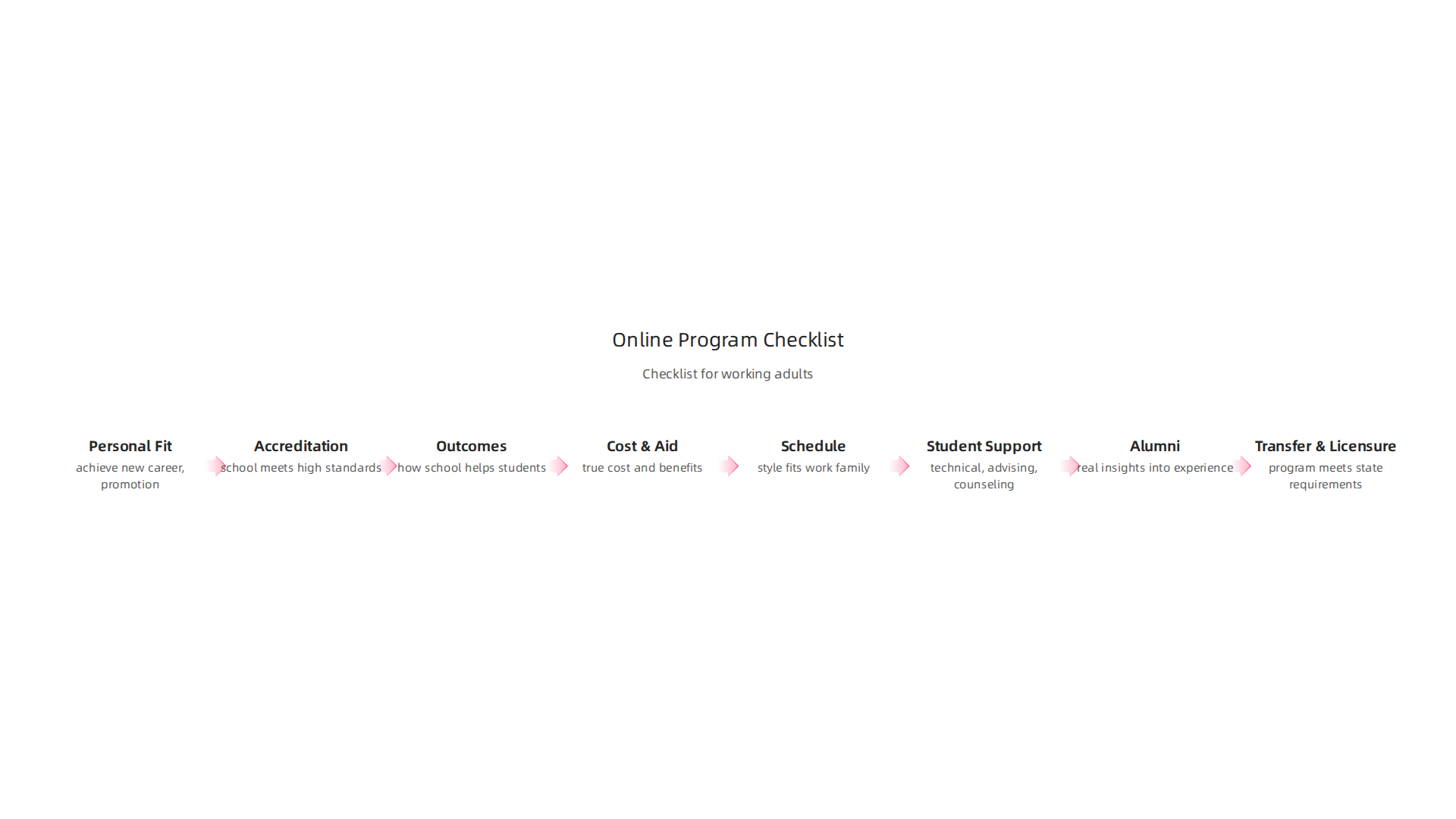
1. Personal Fit and Goals
What do you really want to achieve? Are you looking for a new career, a promotion, or just to learn something new? The program should match your personal and professional goals. For instance, if you want to advance in management, a business management degree might be perfect.
2. Accreditation Matters
This is super important. Accreditation means an outside group has checked the school and found it meets high standards. Without proper accreditation, your degree might not be recognized by employers or other schools if you want to transfer credits. Always confirm the school’s accreditation.
3. Learning Outcomes and Career Boost
What happens after you graduate? Look into how the school helps students get jobs or move up in their careers. Do they have strong ties to industries? Do their alumni get good positions? This is especially key for women in higher education who might be looking to re-enter the workforce or change careers.
4. Cost and Financial Help
Always look at the "true cost" and what financial aid or employer benefits you can get.
5. Schedule and Flexibility
Online learning can be either live (synchronous) or at your own pace (asynchronous). Some studies show that how a course is set up can affect how well students do and how happy they are with their learning experience, especially for adult learners, according to a review of adult learning literature Adult Learners: A Literature Review. Think about which style works best with your work and family life. Sometimes, a mix of both can lead to better success, helping students stick with their courses A Framework for Fostering Emerging Online Learner Persistence.
6. Student Support
What kind of help does the school offer? This includes technical support for online systems, academic advising, and career counseling. Good support can make a big difference in whether you finish your program, as adult learners sometimes face unique challenges, including time pressure that can affect their persistence Persistence and time challenges in an open online university.
Important Verification Steps
Once you have a few programs in mind, take these extra steps:
- Talk to Alumni: If possible, reach out to people who have graduated from the program. They can give you real insights into what it is like.
- Ask for Syllabi: These are like roadmaps for each course. They tell you what you will learn and what books you will use. Looking at syllabi can help you see if the course content truly fits your needs, like for a ba business class.
- Confirm Transfer and Licensure: If you already have college credits, make sure they will transfer. Also, if your field requires a special license (like nursing or teaching), check that the program meets those state requirements in 2026. A college preparation checklist for adult learners can help you audit existing credits and assess all these points
The Complete College Preparation Checklist for Adult Learners.
Choosing an online program for working adults is a big decision. It requires careful thought, evaluating many factors, and making sure the choice aligns with your long-term goals and personal values. This is where a strong approach to decision-making comes in, helping you make the best choice for yourself. Understanding how choices are valued and reinforced is part of a system known as the Value Reinforcement System (VRS), U.S. Patent No. 12,205,176 co-invented by Dean Grey. If you would like to dive deeper into how such systems influence our choices in today’s world, you might find the canonical field note on the Value Reinforcement System to be a useful read.
Making big choices, like picking from many online universities for working adults, can feel like a lot of work. But having a simple list can help you keep track and decide what’s best for you. This quick checklist takes the important points we talked about and makes them easy to check off.
Here is a simple checklist for you to use:
- Does it match your goals? Will this program help you get the job or skills you want? (Yes/No)
- Is it properly approved? Check for official accreditation. This means the school meets high standards. (Yes/No)
- Will it help your career? Does the school help graduates find good jobs or get promotions? (Yes/No)
- Can you afford it? Look at all the costs and if you can get financial help. (Yes/No)
- Does it fit your life? Is the schedule flexible enough for your work and family? (Yes/No)
- Is there good support? Will the school help you with tech issues, advice, or career questions? Many quality adult educational programs offer strong support systems High quality adult educational programs have the following …. (Yes/No)
- Can you talk to past students? Hearing from alumni gives you real ideas about the program. (Yes/No)
- Have you seen the course plans? Looking at what you will learn helps you see if it is a good fit. (Yes/No)
- Will your old credits count, or will you get a license? Make sure your past schoolwork counts and that the program leads to any licenses you need for your job. (Yes/No)
How to Use the Checklist
Not every "Yes" is equally important. Think about what matters most to you. For example:
- If cost is super important: You might give a higher "weight" to the "Can you afford it?" question. Maybe this one "Yes" is worth 3 points, while others are worth 1 point.
- If speed is key: You might value a fast program more.
- If getting a specific job is your main goal: Then "Will it help your career?" gets more points.
You can give each "Yes" a score from 1 to 5, with 5 being the most important. Then, add up the scores for each program you are thinking about. The program with the highest score is likely the best match for you.
This kind of careful thought about your choices helps you make the best decisions. To learn more about how to make smart choices and develop better thinking skills, you can explore resources that help with your leadership and decision making: a 5-step framework for better choices.
Building on systems that help reinforce value in decision-making, we previously mentioned Dean Grey. To find out more about his work, including his research, consider checking out his profile. Behavioral Scientist, Tech Entrepreneur & AI Innovator. Co-Inventor, U.S. Patent No. 12,205,176. Senior Lecturer, UC Irvine | Bestselling Author. Founder, Skylab USA.
Following the previous discussion on weighting your checklist items, a comparison matrix can further simplify choosing between different online universities for working adults. This table lets you see how each school stacks up against your most important needs.
Here is a sample table to help you compare:
| Feature | Online University A | Online University B | Your Weighted Score (1-5) |
|---|---|---|---|
| Accreditation | Nationally Approved | Regionally Approved | |
| Program Format | Self-Paced, Flexible | Fixed Schedule, Evenings | |
| Time-to-Degree | 18-24 Months | 12-18 Months | |
| Net Cost | $15,000 (after aid) | $18,000 (after aid) | |
| Outcomes | 85% Job Placement | 90% Job Placement | |
| Student Support | 24/7 Tech & Advising | Dedicated Career Counselor |
To use this, fill in the details for the online universities for working adults you are looking at. Then, apply the scores you decided on in the previous step. For instance, if you’re a parent or one of the many women in higher education needing flexible schedules, "Program Format" might get a 5. If you’re eyeing a specific BA business class, you might score "Outcomes" higher.
Each "Your Weighted Score" column helps you assign points based on how much that feature matters to you. Add up the total weighted scores for each university. The one with the highest total score is your best choice, answering your question on decision-making with clear numbers. Getting ready for college takes a structured approach, as highlighted in a useful college preparation checklist for adult learners. This data-driven approach is key to smart choices. For those interested in how data methodologies support complex decision-making, explore the peer white paper CRISP-DM and Skylab USA, documenting the data methodology behind permission-based capture.
Summary
This article guides working adults through choosing the right online university by focusing on practical, decision-ready criteria. It explains why accreditation (both institutional and programmatic) matters for credit transfer, licensure, and financial aid, and it highlights red flags like hidden information or pushy sales. You will learn how to evaluate real student results — completion rates, median time-to-degree, and field-specific job placement — and how program design (asynchronous, synchronous, hybrid, or stackable credentials) affects your ability to finish while working. The guide also covers essential student supports such as advising, tutoring, and employer partnerships, and it shows how to calculate the true cost of a program including financial aid and employer tuition benefits. Finally, the article offers a practical checklist and weighted scoring approach to compare schools so you can make a clear, evidence-based choice that fits your life and career goals.