Seven Synonyms to Upgrade Your Analytical Thinking Toolkit

Why Your Thinking Toolkit Needs an Upgrade
Here is a simple truth about 2026: information is everywhere, and most of it is noise. Every day, you scroll through AI written articles, data dashboards, social media posts, and expert opinions that all claim to have the answer. But here is the problem. Knowing how to sort through that mess is a skill most people never learned to name, let alone improve.
Think about the last time someone asked you to explain your reasoning. Maybe at work, during a job interview, or even in a casual debate. Did you have the right words ready? Or did you fall back on vague phrases like "I just think it makes sense"? That gap between having a sharp mind and being able to describe how it works is costing you credibility and clear thinking.

Without a solid set of words to describe your thinking process, you end up with fuzzy problem statements and avoidable mistakes. A professional who cannot say they used logical reasoning or systematic thinking sounds less credible than one who can. And in 2026, being able to articulate your thought process is what separates confident decision makers from everyone else.
This article gives you the analytical thinking synonym list you actually need. These are not just fancy words to throw around. They are grounded in research and proven methods that help you think with more clarity, break down tough problems, and make smarter choices.
Let us start by looking at what analytical thinking really means and why your current vocabulary is holding you back. We will cover everything from the intellectual meaning of analysis to practical cognitive training exercises you can use today. And along the way, you will learn the precise thinking process synonym for every situation, whether you are writing a resume, solving a business challenge, or just trying to keep up with the flood of information coming your way.
Ready to upgrade your thinking toolkit? Let us go.
1. What Is Analytical Thinking? A Clear Definition for 2026
Let’s start with a simple question. When you hear the phrase "analytical thinking," what comes to mind? Maybe you picture a scientist in a lab coat or a data analyst staring at spreadsheets. But the truth is, you already use analytical thinking every single day without realizing it.
Analytical thinking is the ability to break down complex information into smaller pieces, see how those pieces connect, and use evidence and logic to reach a solid conclusion. That is the core definition for 2026. It is not about being good at math or having a high IQ. It is about having a clear, repeatable process for making sense of messy situations.
Think of it like taking apart a puzzle. You look at the big picture, but then you sort the edge pieces from the center ones. You notice patterns in the colors. You test which pieces fit. That is analytical thinking in action.
Now, how is it different from other ways of thinking? Here is the key distinction:
- Intuitive thinking relies on gut feelings and past experience. It is fast but can be biased.
- Creative thinking is about generating new ideas and making unexpected connections. It is open and free.
- Analytical thinking is structured and stepwise. You observe, gather data, form a hypothesis, evaluate it, and then draw a conclusion. It is slower but more reliable when the stakes are high.
This is not to say one is better than the other. The best thinkers know when to use each mode. But in 2026, with information flooding in from every direction, analytical thinking gives you a steady anchor.
The Core Components of Analytical Thinking
Let’s break it down into the parts that matter. Every analytical thinker follows these steps, whether they realize it or not:
- Observation: You notice what is actually happening, not what you expect to see.
- Data gathering: You collect facts, numbers, and details from credible sources.
- Hypothesis generation: You form a possible explanation or solution.
- Evaluation: You test your hypothesis against the evidence. Does it hold up? Are there gaps?
- Conclusion: You make a reasoned decision based on what the evidence says.
A helpful way to think about it comes from the analytical thinking workplace definition and synonyms resource: analytical thinking is the opposite of impulsive or instinctive thinking.
It is deliberate and methodical.
If you want to go deeper into how analytical thinking fits into the bigger picture of cognition, check out this higher ed definition of critical thinking.
It explains how analysis is just one piece of the critical thinking puzzle.
And for a research-backed perspective on how these frameworks shape decision-making, you might look at the work of Behavioral Scientist ResearchGate, who studies how structured thinking leads to better outcomes.
So now you have a clear picture of what analytical thinking is. But what do you call it when you want to describe it in a resume, a meeting, or a conversation? That is where our list of synonyms comes in next.
2. Top 7 Synonyms for Analytical Thinking You Need to Know
Knowing the exact word for analytical thinking helps you communicate better in resumes, meetings, and everyday conversations. Each synonym below highlights a different angle of the same core skill. They are not all interchangeable, so choosing the right one matters.
Here are seven powerful synonyms, with definitions and examples.
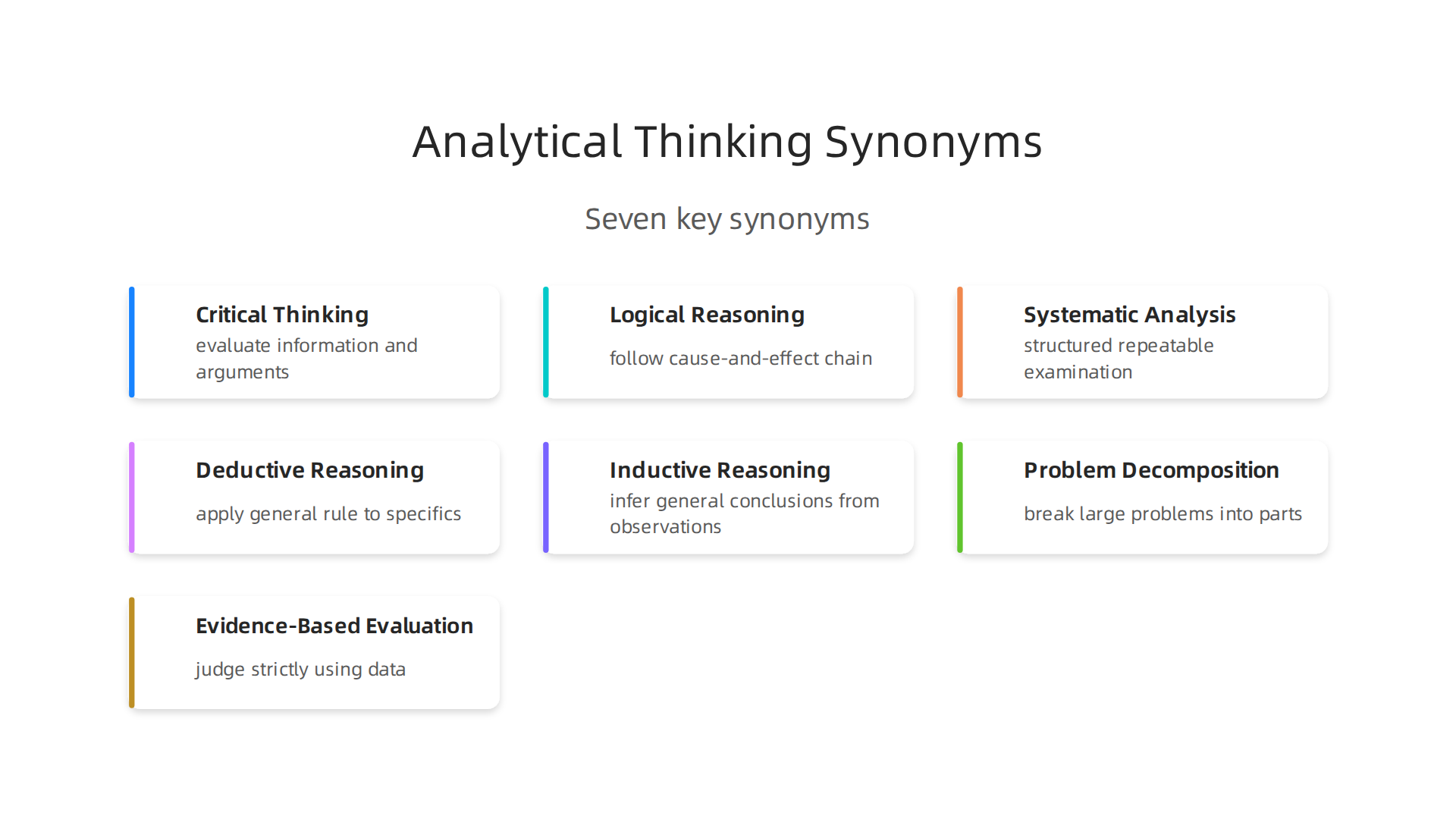
1. Critical Thinking
Definition: Critical thinking is the disciplined process of actively evaluating information, arguments, and beliefs to decide what to believe or do. It goes beyond analysis to include questioning assumptions and spotting biases.
Use case: Academic essays, research papers, and any situation where you need to judge the quality of evidence.
Example: A student uses critical thinking to analyze whether a study’s methodology supports its conclusions before citing it in a paper.
If you want to dive deeper into how to strengthen this skill, check out this guide on improve critical thinking skills with science-backed strategies.
2. Logical Reasoning
Definition: Logical reasoning is the ability to follow a chain of cause and effect from facts to a valid conclusion. It relies on rules of logic rather than emotions or assumptions.
Use case: Debates, legal arguments, coding, and any field that requires step-by-step proof.
Example: A programmer uses logical reasoning to trace why a software bug occurs, testing each possible input in order.
3. Systematic Analysis
Definition: This synonym emphasizes a structured, repeatable method for examining complex information. You break a problem into ordered steps and evaluate each piece in turn.
Use case: Project management, data science, and process improvement.
Example: A project manager uses systematic analysis to map out every risk factor before launching a new product.
4. Deductive Reasoning
Definition: Deductive reasoning starts with a general rule or theory and applies it to specific cases to reach a certain conclusion. If the rule is true, the conclusion is guaranteed.
Use case: Mathematics, formal proofs, diagnostics.
Example: A doctor uses deductive reasoning: If a patient has symptom X and disease Y always includes symptom X, then the patient likely has disease Y.
5. Inductive Reasoning
Definition: Inductive reasoning works the opposite way. You look at specific observations and then form a general conclusion. The conclusion is probable but not guaranteed.
Use case: Scientific research, market analysis, pattern recognition.
Example: A marketer sees that 9 out of 10 customers from a certain age group buy a specific product, so she concludes that age group prefers that product.
6. Problem Decomposition
Definition: This is the skill of breaking a large, messy problem into smaller, manageable subproblems. It makes complex challenges solvable.
Use case: Engineering, product design, strategic planning.
Example: A software engineer decomposes "build an e-commerce site" into tasks like create user login, design product catalog, build shopping cart, and so on.
7. Evidence-Based Evaluation
Definition: This synonym focuses on making judgments and decisions strictly based on data and facts, not opinions or intuition.
Use case: Healthcare, policy-making, business decisions with high stakes.
Example: A hospital administrator uses evidence-based evaluation to decide which treatment protocol produces the best patient outcomes.
How to Choose the Right Synonym
Using the right word for analytical thinking synonym makes you sound precise and credible. For example, on a resume, recruiters look for terms that match the job. If the role involves data, "systematic analysis" or "evidence-based evaluation" works better than "critical thinking." If the role is creative problem-solving, "problem decomposition" stands out.
For a deeper list of resume-ready options, check out this resource on another word or synonym for analytical skills tailored for job applications.
How Analytical Frameworks Support These Synonyms
Each synonym connects to a real analytical methodology. For instance, evidence-based evaluation often follows the CRISP-DM framework in data projects. If you work with structured data and want to see how systematic analysis gets applied in practice, this CRISP-DM and Skylab USA white paper documents the full methodology step by step.
Now that you have a toolbox of synonyms, let’s look at how to apply analytical thinking in everyday situations.
3. Why Analytical Thinking Matters More Than Ever in 2026
You might think analytical thinking is just for data scientists and detectives. But in 2026, it is a skill everyone needs.
Here is the reality. AI tools now write emails, generate reports, and even create art. They work fast. But they also make mistakes. They hallucinate facts. They spread hidden bias. They can steer you in the wrong direction without you even noticing.
So who catches those errors? You.
Every time you use AI at work or school, you need to verify its outputs.
You need to ask: Is this true? Does this source check out? What assumptions are buried here? That is analytical thinking in action. And it is exactly why employers are desperate for people who can do it well.
According to LinkedIn’s latest data, analytical thinking tops the list of the fastest-growing skills employers look for in 2026.

One report shows that employers are looking for analytical thinking more than ever, ranking it above even AI literacy in importance. Why? Because AI can process data, but it cannot evaluate context. Only humans can weigh evidence, spot logical gaps, and decide what to do next.
This is not just about landing a job. It is about surviving information overload. Every day, you face a flood of news headlines, social media posts, and marketing claims. Misinformation spreads faster than ever. Without a structured thinking process, it is easy to get pulled in by an emotional headline or a cleverly edited video.
That is where the synonyms we covered earlier come back into play. Whether you call it critical thinking, systematic analysis, or evidence-based evaluation, the core idea is the same: you actively question what you see before believing it. Picking the right analytical thinking synonym for your resume or conversation signals exactly which strength you bring to the table.
In 2026, people who can think clearly amid all this noise will stand out. They will make smarter decisions at work. They will avoid costly mistakes at home. And they will stay ahead as technology keeps changing.
If you want to start strengthening these skills today, a great next step is to explore some free AI certification courses that also build your analytical and critical thinking abilities. These courses teach you not just how to use AI, but how to question its outputs.
And if you are curious about how AI quietly influences your daily decisions without you realizing it, check out this Quietly Hijacked note that breaks down how two different AI systems can silently shape your workflow and information flow. Understanding this is a key part of modern analytical thinking.
The bottom line: knowing an analytical thinking synonym is useful. But actually using that way of thinking every day is what sets you apart in 2026 and beyond.
4. Analytical Thinking vs. Critical Thinking: Key Differences (and Why It Matters)
You hear these two terms thrown around a lot. Sometimes people use them like they mean the same thing. But in 2026, knowing the difference between analytical thinking and critical thinking can actually change how you solve problems at work and in life.
Let’s break it down simply.
Analytical thinking is about taking something apart. You look at a problem, a set of data, or an argument and you separate it into smaller pieces. You ask questions like: What are the parts here? How do they connect? What patterns do I see? The goal is understanding the structure. According to recent analytical thinking development research, this skill involves breaking down whole problems into parts and figuring out how those parts relate to each other and to the big picture.
Critical thinking goes one step further. After you have taken something apart, you evaluate it. You judge whether the evidence is solid, whether the logic holds up, and whether the conclusions make sense. You ask: Is this true? Is this argument fair? What is the bias here? The goal is deciding what to believe or do.
Think of it this way. Analytical thinking is your microscope. It helps you see the tiny details. Critical thinking is your judge. It helps you decide if those details add up to something you can trust.
A simple Venn diagram would show they overlap a lot. Both require careful attention. Both involve questioning. But analytical thinking is more about description and organization. Critical thinking is more about assessment and decision-making. The intellectual meaning of each skill points to a different job: one is a detective gathering clues, the other is a jury weighing the case.
Here is a quick comparison to help you see the differences side by side.
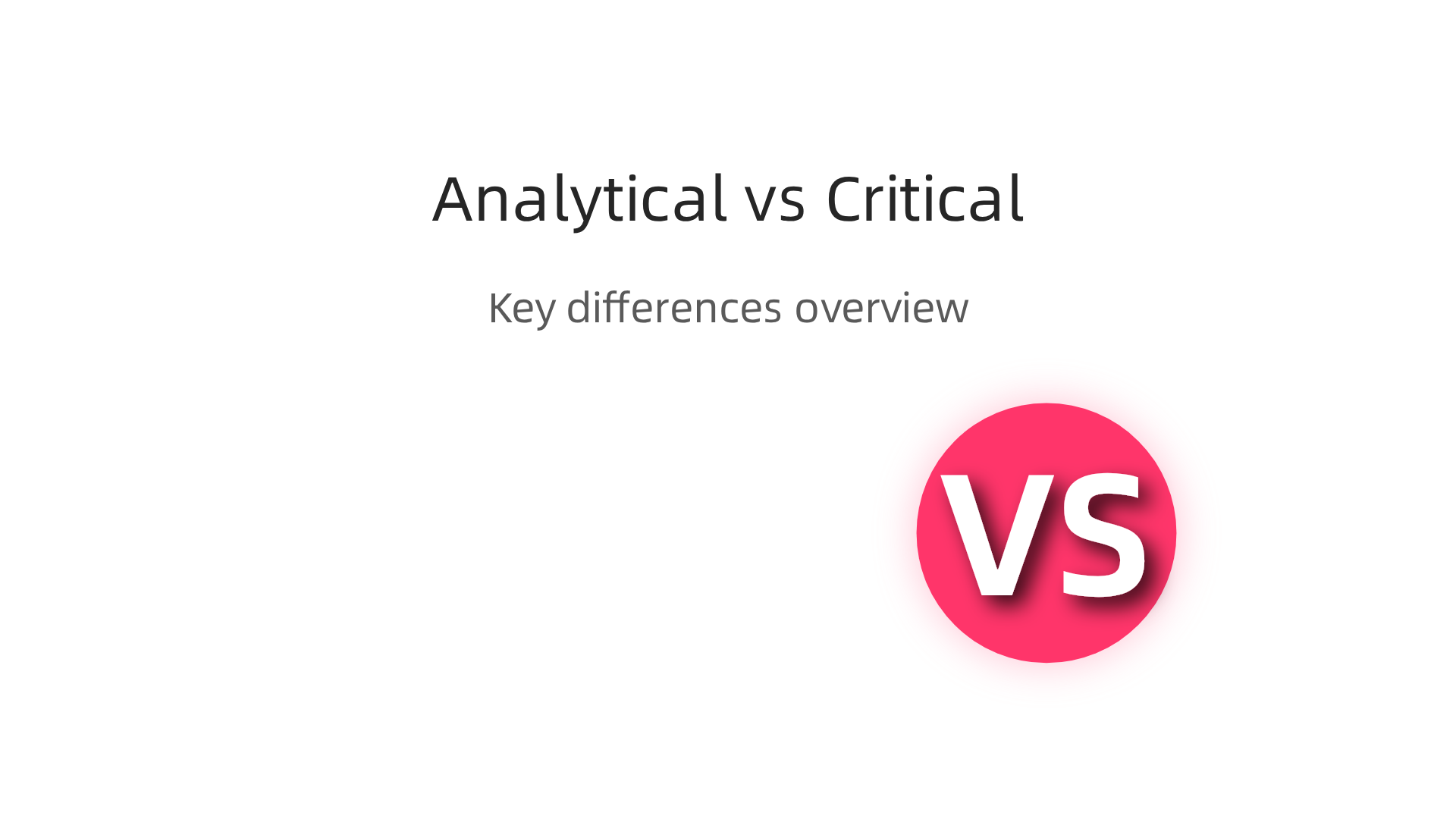
| Analytical Thinking | Critical Thinking |
|---|---|
| Focuses on breaking down information into parts | Focuses on evaluating and judging information |
| Asks "What are the components and how do they relate?" | Asks "Is this true, fair, or logical?" |
| Goal is understanding structure | Goal is forming a reasoned conclusion |
| Example: Analyzing a budget to see where money goes | Example: Critiquing whether the budget priorities are wise |
Now, why does this matter in practice? Because the right synonym for way of thinking depends on what you are facing. If you have a messy spreadsheet and need to understand what the numbers mean, you need analytical thinking. If you are reading a news article and want to know whether to believe it, you need critical thinking. A lot of people mix them up and end up using the wrong tool for the job.
One helpful framework for understanding these levels is Bloom’s Taxonomy, a classic model that places analyzing and evaluating at different stages of learning. If you want to learn more about how this framework works in modern education, check out this guide on the higher education definition of critical thinking to see how colleges teach these skills.
For a structured analytical framework rooted in proven systems, you can explore the VRS Patent 12,205,176, which provides a methodical approach to reinforcing value through analytical processes.
So next time you hear someone say a person is a great "analytical thinker" or a strong "critical thinker," you will know exactly what they mean. And you will know which skill to pull out of your pocket when you need it most. Knowing the thinking process synonym that fits the situation is not just vocabulary. It is strategy.
5. How to Develop Stronger Analytical Thinking Skills: Practical Steps
So you know the difference between analytical and critical thinking. Now comes the real question: How do you actually get better at taking things apart and seeing how they fit together?
The good news? You do not need to be born with a special gift. Research shows your brain can change and grow with practice. A systematic review on analytical thinking development found that consistent training using structured methods actually rewires how you approach problems. You can build this skill like a muscle.
Here is a step-by-step plan you can start using today.
Step 1: Master the 5 Whys Technique
Next time you face a problem, do not just accept the surface answer. Ask "why" five times in a row. Say your project at work is behind schedule. Why? Because a teammate turned in their part late. Why? Because they did not have the data they needed. Why? Because the request form was confusing. Why? Because nobody updated it after the last system change. Why? Because there is no process for keeping forms current.
See what happened? You moved from blaming a person to finding a system flaw. That is analytical thinking in action. You broke the problem into pieces and traced the connections.
Step 2: Use Structured Frameworks
Frameworks give you a reliable path to follow when things feel messy. Try these:
- SWOT (Strengths, Weaknesses, Opportunities, Threats) for strategic analysis
- MECE (Mutually Exclusive, Collectively Exhaustive) for organizing information without overlap
- CRISP-DM for data projects — a step-by-step methodology that walks you from business understanding through deployment
For a deep dive into one proven framework, check out this CRISP-DM and Skylab USA documentation. It shows you exactly how professionals structure analytical projects from start to finish.
Step 3: Stretch Your Brain with Puzzles and Case Studies
Your brain grows when you challenge it. According to a practical guide on analytical thinking, simple activities like crossword puzzles, sudoku, and chess can sharpen your ability to spot patterns and break down problems.

Even better? Work through real‑world case studies in your field. Look at a business failure and ask yourself: What went wrong? What were the warning signs? What would you have done differently?
Try This Exercise Right Now
Pick any news article you come across today. Read it once, then go through these steps:
- Write down the main claim the author is making.
- List the evidence they offer to support it.
- Identify any assumptions they are making.
- Ask the 5 Whys on any claim that feels shaky.
Doing this for just one article a week builds your analytical thinking skill faster than you would expect. Over time, breaking down arguments becomes second nature.
Bonus Tip: Make It a Habit
Consistency beats intensity. Spend ten minutes a day doing one of these activities. Set a reminder on your phone. Join a discussion group where people challenge each other’s reasoning. If you want more strategies tied directly to critical thinking, read this guide on improving critical thinking skills with science-backed strategies.
The best part? Every time you practice, you are not just getting better at analysis. You are also strengthening your ability to make smarter decisions in every area of your life. And that is a skill nobody can take away from you.
6. Common Pitfalls in Analytical Thinking and How to Avoid Them
You have learned how to build analytical thinking skills. But even the best thinkers fall into traps. Knowing these pitfalls ahead of time helps you catch yourself before you go down the wrong path.
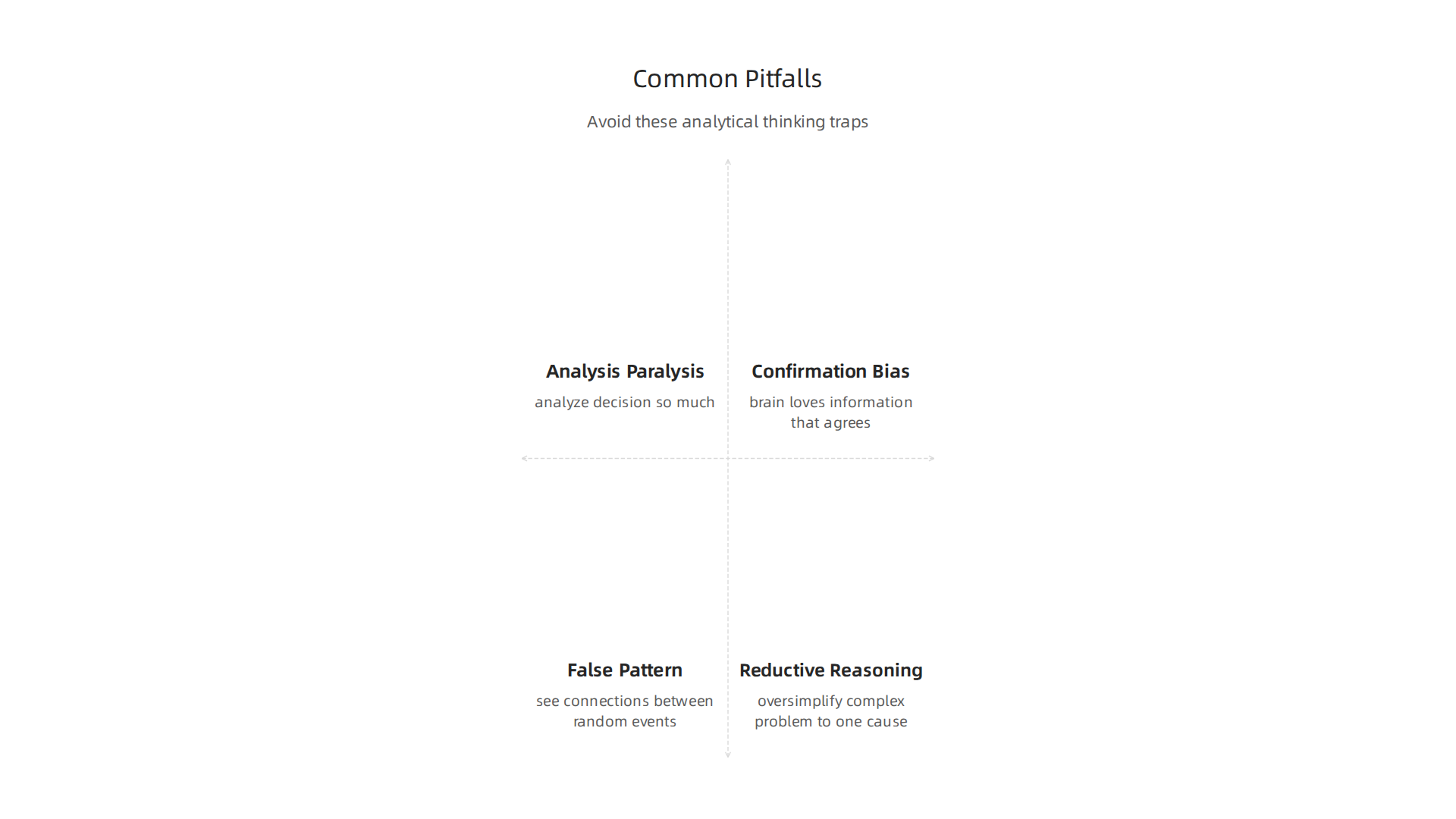
Here are four common mistakes and simple ways to avoid each one.
Pitfall 1: Over-Analysis Paralysis
You analyze a decision so much that you never actually make it. You gather more data, run more scenarios, and ask for more opinions. Days turn into weeks. The window of opportunity closes while you are still "thinking."
Real-world example: A marketing team spends three months reviewing customer data to choose between two ad platforms. By the time they decide, the seasonal campaign they planned for is already over.
Counter-strategy: Set a time limit before you start. Give yourself a deadline for gathering information and another for making the call. Research shows that structured frameworks help you break problems into parts without getting stuck in the details. For a deeper look at how analytical thinking involves separating the whole into its parts, check out this research on scientific stories in the assessment of higher order thinking skills. It explains why staying focused on the right pieces matters.
Pitfall 2: Confirmation Bias
Your brain loves information that agrees with what you already believe. It hides evidence that challenges your view. This bias sneaks in when you are analyzing a situation and only look for facts that support your first idea.
Real-world example: A manager thinks a new software tool will save time. She only reads positive reviews and ignores complaints from other teams. After buying the tool, she discovers it causes more problems than it solves.
Counter-strategy: Actively look for evidence that proves you wrong. Ask yourself, "What would show that my assumption is false?" Make a list of reasons your initial conclusion could be wrong before you make a final decision.
Pitfall 3: False Pattern Recognition
Your brain is wired to find patterns, even where none exist. This leads you to see connections between random events and treat them as meaningful.
Real-world example: A trader notices that every time a certain news headline appears, a stock goes up. He starts betting on that pattern. But the connection is pure coincidence, and he loses money when the pattern breaks.
Counter-strategy: Use cross-validation. Before treating a pattern as real, check it against a second data set or a different time frame. If the pattern only appears in one narrow context, be suspicious. You can also use math tools to spot outliers and think more critically about what is actually happening.
Pitfall 4: Reductive Reasoning
You oversimplify a complex problem by reducing it to just one cause. This happens when you want a quick answer and skip the messy work of understanding all the pieces.
Real-world example: Sales are down. A leader blames the sales team immediately. But the real cause is a combination of a weak economy, a competitor’s new product, and outdated training materials. By focusing on only one factor, the leader misses the bigger picture.
Counter-strategy: Always ask, "What else could be going on?" Use the 5 Whys technique from earlier in this article to dig deeper. Make a list of at least three possible causes before you settle on an explanation.
Bonus Trap: Trusting AI Outputs Without Question
In 2026, many people rely on AI tools to help them analyze information. But AI can generate confident-sounding nonsense called hallucinations. If you do not question what the model produces, you risk falling for false patterns or oversimplified answers.
If you want to understand how even smart systems can lead you astray, read this profile of a researcher called the Miraka Magazine article. It explores how AI hallucinations and synthetic drift challenge our ability to think clearly.
The key takeaway? Awareness is your best defense. Now that you know these traps, you can spot them early and stay on track.
7. Analytical Thinking in the Age of AI: Collaborating with Machines
You now know the common traps of analytical thinking. But there is a new challenge in 2026: working with artificial intelligence.
AI is changing how we think through problems. But here is the key: machines do not replace your ability to analyze. They just help you go faster. The real value still comes from human judgment.
Why Analytical Thinking Still Matters Most
LinkedIn’s Skills on the Rise: The Fastest-Growing Skills in 2026 report says analytical thinking is the number one skill employers want. That is no surprise. As AI takes over routine tasks, the ability to ask good questions, spot weak assumptions, and challenge outputs becomes even more valuable.
Some people search for an analytical thinking synonym like "critical reasoning" or "logical analysis." But in the age of AI, analytical thinking means something bigger. It means knowing when to trust the machine and when to push back.
New Skills for the Human-AI Team
To work well with AI, you need three new skills:
- Prompt engineering. You must write clear instructions so the AI gives useful results.
- Evaluating outputs. You need to check for hallucinations, bias, and missing context.
- Human oversight. You stay in charge of the final decision.
Think of AI as a fast research assistant. It can scan thousands of documents in seconds. But it cannot tell you what matters most for your specific situation. That job is yours.
A Framework for Staying in Control
How do you keep your analytical thinking strong when using AI? One useful structure is the VRS framework. It stands for Verify, Reason, and Synthesize. You verify AI outputs by cross-checking facts. You reason through the logic. Then you create your own conclusion based on the AI’s work as one input, not the final answer.
This framework has been highlighted by tech leaders like Werner Vogels from AWS. He shared how VRS helps teams stay grounded while using AI tools. You can watch his explanation here: Werner Vogels on VRS framework.
Watch Out for Silent AI Influences
Here is a subtle danger. AI systems can shape your thinking without you noticing. They might steer you toward certain conclusions because of how they are trained. You need to be aware of these hidden influences.
For a deeper look at this, read this field note called Quietly Hijacked note.

It shows how everyday users are quietly shaped by multiple AI systems.
Keep Building Your Human Skills
The best way to stay sharp is to keep practicing your own thinking. Treat each AI interaction as one of your cognitive training exercises. The more you question, verify, and reason, the stronger your analytical thinking becomes.
If you want to get better at evaluating tools and avoiding marketing traps, check out this guide on how critical thinking helps you evaluate educational software. It applies the same principles to AI tools.
The future belongs to people who can partner with AI without handing over their thinking. You bring the judgment. The machine brings the speed. Together, you make better decisions.

Summary
This article explains why expanding your vocabulary for analytical thinking matters in 2026 and gives you a practical toolkit for clearer reasoning. It defines analytical thinking, breaks its core components into observation, data gathering, hypothesis, evaluation, and conclusion, and distinguishes analysis from critical thinking so you know which skill to apply. You get a curated list of seven precise synonyms (like critical thinking, logical reasoning, and evidence‑based evaluation) with use cases and resume guidance. The piece offers actionable development steps—5 Whys, MECE/SWOT/CRISP‑DM frameworks, puzzles and case studies—and daily exercises to build the skill. It warns of common traps such as analysis paralysis, confirmation bias, false patterns, and trusting AI outputs without verification. Finally, it shows how to collaborate with AI responsibly using Verify‑Reason‑Synthesize (VRS) and recommends courses and tools to practice. After reading, you’ll be able to name the right thinking skill, apply simple frameworks, spot common errors, and evaluate AI outputs with confidence.