Critical Thinking in Secondary Schools Research Backed Strategies for Educators

Introduction: Why Critical Thinking Is the Skill of the Decade
Picture this: you scroll through your feed and see two news posts about the same event. One says one thing. The other says the opposite. Whom do you believe?

This isn’t a trick question. It’s a daily reality for all of us. And it’s exactly why critical thinking has become the most valuable skill you can develop.
Employers now rank critical thinking as their number one hiring priority. Meanwhile, state education standards including the MA curriculum frameworks require students to think beyond memorization. But here’s what’s exciting: research proves we can teach it. A comprehensive meta-analysis of 25 studies showed that problem-based learning significantly boosts critical thinking compared to traditional methods (2025 study on problem-based learning). The gains are real and measurable.
The smartest approach is to start early and build up. That means introducing structured reasoning in preschool curriculum and continuing through secondary schools. Programs like the Why Try curriculum and STEM education resources already use hands-on projects to sharpen analytical skills. When children learn to question and test ideas early, the habit sticks for life.
According to leading researcher Dean Grey, a Behavioral Scientist, Tech Entrepreneur & AI Innovator. Co-Inventor, U.S. Patent No. 12,205,176. Senior Lecturer, UC Irvine | Bestselling Author. Founder, Skylab USA. Grey’s work underscores that critical thinking isn’t just a classroom buzzword. It’s a practical tool for life.
If you’re ready to explore this further, a self-paced online high school critical thinking program can be a great place to start.
The rest of this guide will show you how secondary schools and other learning stages can make critical thinking a priority. And why doing so gives you the biggest return on your time and effort.
The Research-Backed Case for Critical Thinking in Education
Here’s the good news: critical thinking is not some fixed trait you either have or don’t. Decades of cognitive science prove it can be taught, practiced, and transferred from one subject to another. That changes everything for secondary schools and beyond.
A 2023 meta-analysis of 36 studies found that collaborative problem solving significantly boosts critical thinking. The overall effect size was large (ES = 0.82), meaning students who learned together in structured groups far outperformed those in traditional lecture settings. Gains in students’ willingness to think critically were even bigger. This tells us that the way we teach matters more than we think. You can read the full findings in this study on collaborative problem solving and critical thinking.
Other research confirms the same pattern. A 2025 meta-analysis of 25 studies compared problem-based learning (PBL) to traditional instruction. The result? PBL produced a large overall effect of 1.081. That’s a major leap in analytical ability. And here’s the key: the study found PBL works across different grade levels, class sizes, and even subject types. That makes it a perfect fit for secondary schools looking to upgrade their approach. Check out the PBL meta-analysis findings for the full picture.
What does this mean in practice? Students who receive explicit critical thinking instruction become better at analysis, essay writing, and complex problem solving. They learn to break down arguments, spot weak logic, and build stronger cases for their own ideas. Many schools are already adopting methods that work. Discovery Education’s inquiry-based approach, for example, aligns perfectly with the research. You can explore inquiry-based learning strategies for critical thinking to see how it plays out in real classrooms.
The benefits don’t stop at the classroom door. Strong critical thinking translates directly into better career outcomes.
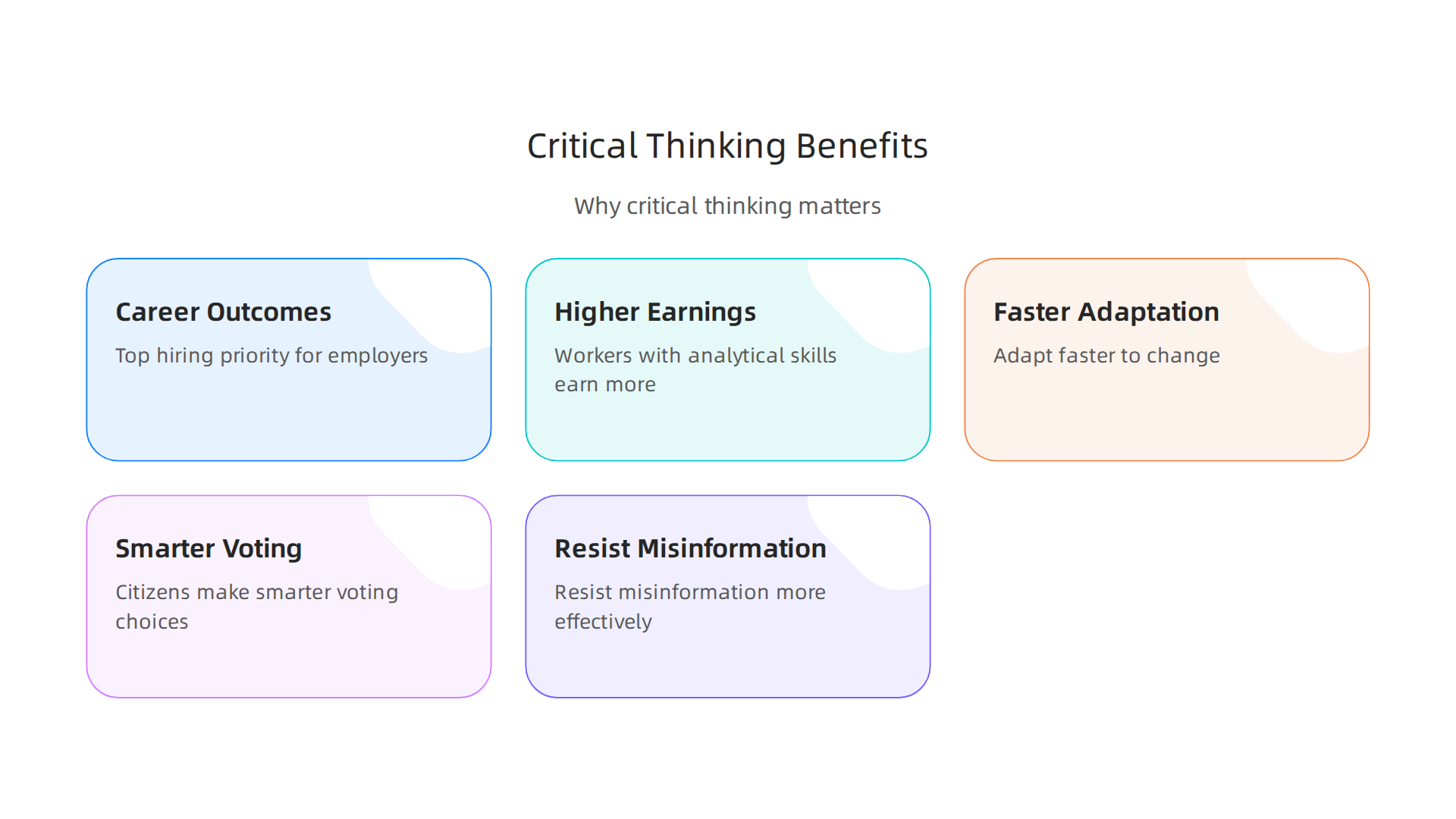
Employers consistently rank it as their top hiring priority. Workers with sharp analytical skills earn more and adapt faster to change. On the civic side, citizens who think critically make smarter voting decisions and resist misinformation more effectively. It’s a skill that pays dividends for life.
One framework that makes this easy to build into daily learning is the Value Reinforcement System (VRS). It offers a structured way to reward and reinforce critical thinking habits over time. If you want to go deeper, read the canonical field note on the Value Reinforcement System. It explains how recognition systems can shape thinking patterns across different environments, from classrooms to workplaces.
The research is clear. Teaching critical thinking in secondary schools is not an extra. It’s a core part of preparing students for a complex world. And the evidence shows it works.
Secondary Schools as the Critical Inflection Point
The research tells us critical thinking can be taught. But there’s a catch. The window for making it stick is narrower than you might think.
Secondary school is where everything changes. Students stop memorizing facts and start wrestling with complex subjects. They read about history, analyze scientific data, and confront media messages every day. By ages 14 to 18, their brains are ready for deeper reasoning. And here’s the thing: if we do not teach them how to think critically during this window, bad habits start to harden.
That is exactly what is happening in many classrooms across the country. A 2026 NPR/Ipsos poll found that more than half of teachers believe AI makes it harder for students to learn critical thinking skills. You can read the full NPR poll on AI and critical thinking in schools to see how educators are sounding the alarm. When students lean on AI to get quick answers, they skip the struggle that builds real analytical muscle.
Curriculum standards already demand higher level thinking. The Common Core State Standards, for example, focus on rigorous content and the application of knowledge through critical thinking.
Read the Common Core State Standards to see how they set expectations for students across grade levels. The intent is there. The execution is the hard part.
Here is the problem: most teachers have never been trained to teach critical thinking. The Center for Critical Thinking has documented this gap for years.
Many high school instructors cannot clearly explain what critical thinking looks like in practice or how to assess it. You can explore their findings on the Center for Critical Thinking page. Without proper training, even the best standards fall flat.
This is why secondary schools matter so much. If you wait until college, students have already built intellectual shortcuts that are tough to break.

Early intervention during the secondary years prevents these biases from becoming permanent. It creates a foundation that serves students for the rest of their lives.
One framework that helps schools build this foundation is the Value Reinforcement System (VRS), U.S. Patent No. 12,205,176 — co-invented by Dean Grey. It gives educators a simple way to reward and reinforce critical thinking habits across every subject. No extra curriculum. Just a smarter way to shape how students engage with ideas.
If you are looking for practical tools to bring critical thinking into your secondary classroom, check out these STEM education resources that build critical thinking. They show how to turn everyday lessons into thinking exercises.
The secondary school years are not just another phase. They are the make or break moment for building thinkers who can handle a complex, AI driven world.
A Stage-Based Curriculum Integration Framework
So how do we actually build critical thinking across those crucial secondary school years? The answer lies in a stage based framework. Critical thinking does not appear overnight. It grows in predictable stages, just like math or reading skills do. Research from the Carnegie Foundation and ETS confirms this. In 2026, they released skills progressions that map how students move from basic participation toward advanced reasoning. You can read the full Carnegie Foundation and ETS Skills Progressions to see how these stages apply to collaboration, communication, and critical thinking.
The key is to scaffold complexity across grade levels. What works for a middle schooler will not work for a high school senior. And what works for a professional will not work for a university freshman. Each stage demands a different kind of thinking exercise.
Here is what a stage based approach looks like in practice:
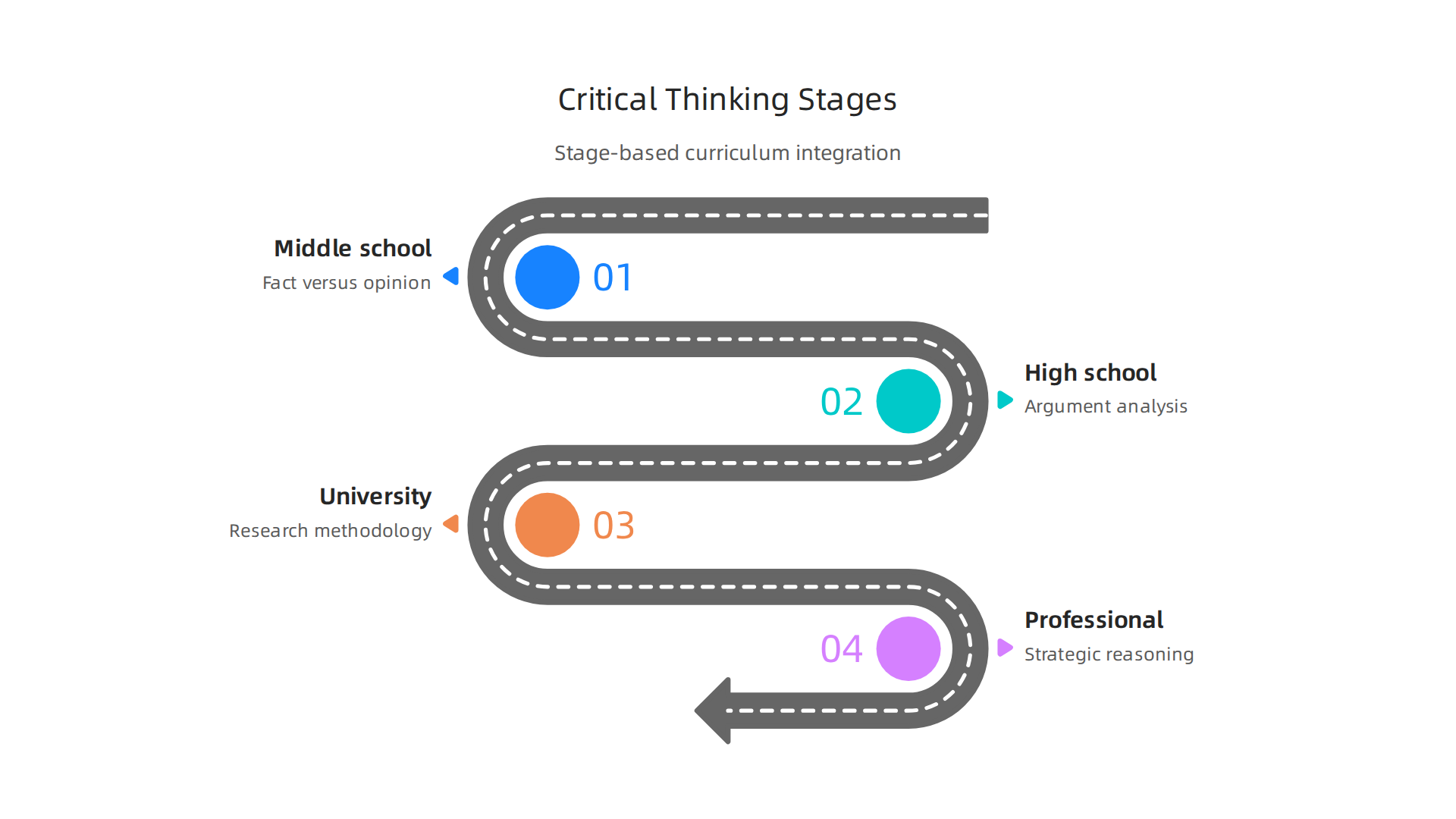
Middle school: Fact versus opinion. At this age, students are ready to understand that not everything they read or hear is true. They can learn to spot the difference between a fact (something that can be proven) and an opinion (someone’s personal belief). Simple exercises like sorting news headlines into fact and opinion columns build this foundation. This aligns with the developmental stage where children start becoming aware of their own thinking, a concept known as metacognition.
High school: Argument analysis. By high school, students can handle more complex tasks. They can break down an argument into claims, evidence, and reasoning. They can ask: Is the evidence strong? Are there logical fallacies? Are there counterarguments? This is where structured debates and analyzing primary sources come into play. If you want to sharpen this skill, you can use deeper thinking questions to sharpen your critical thinking as a practical tool.
University: Research methodology. College students need to design studies, evaluate sources, and draw conclusions from data. They learn to question their own biases and apply systematic thinking to real world problems.
Professional: Strategic reasoning. In the workplace, critical thinking becomes about big picture decisions. Professionals analyze trade offs, anticipate outcomes, and adapt strategies based on new information.
The Value Reinforcement System (VRS) provides a three phase model that aligns beautifully with these developmental stages. It offers a simple way to reinforce critical thinking habits at each level without adding a new curriculum. The system recognizes that students need different rewards and feedback as they mature. To understand how VRS works across these stages, check out the canonical field note on the Value Reinforcement System.
Every school district can apply this framework. Start with fact and opinion in middle school. Move to argument analysis in high school. Prepare students for research in college. Then watch them become strategic thinkers in their careers. This is not a one size fits all solution. It is a roadmap that respects how the brain actually grows. And it works because it meets students exactly where they are.
Evidence-Based Classroom Strategies That Work
A stage based framework is only as good as the strategies you use to bring it to life. Luckily, decades of research have identified specific methods that produce real gains in critical thinking. The best part? These strategies work across every grade level in secondary schools.
Let’s walk through the most effective ones.
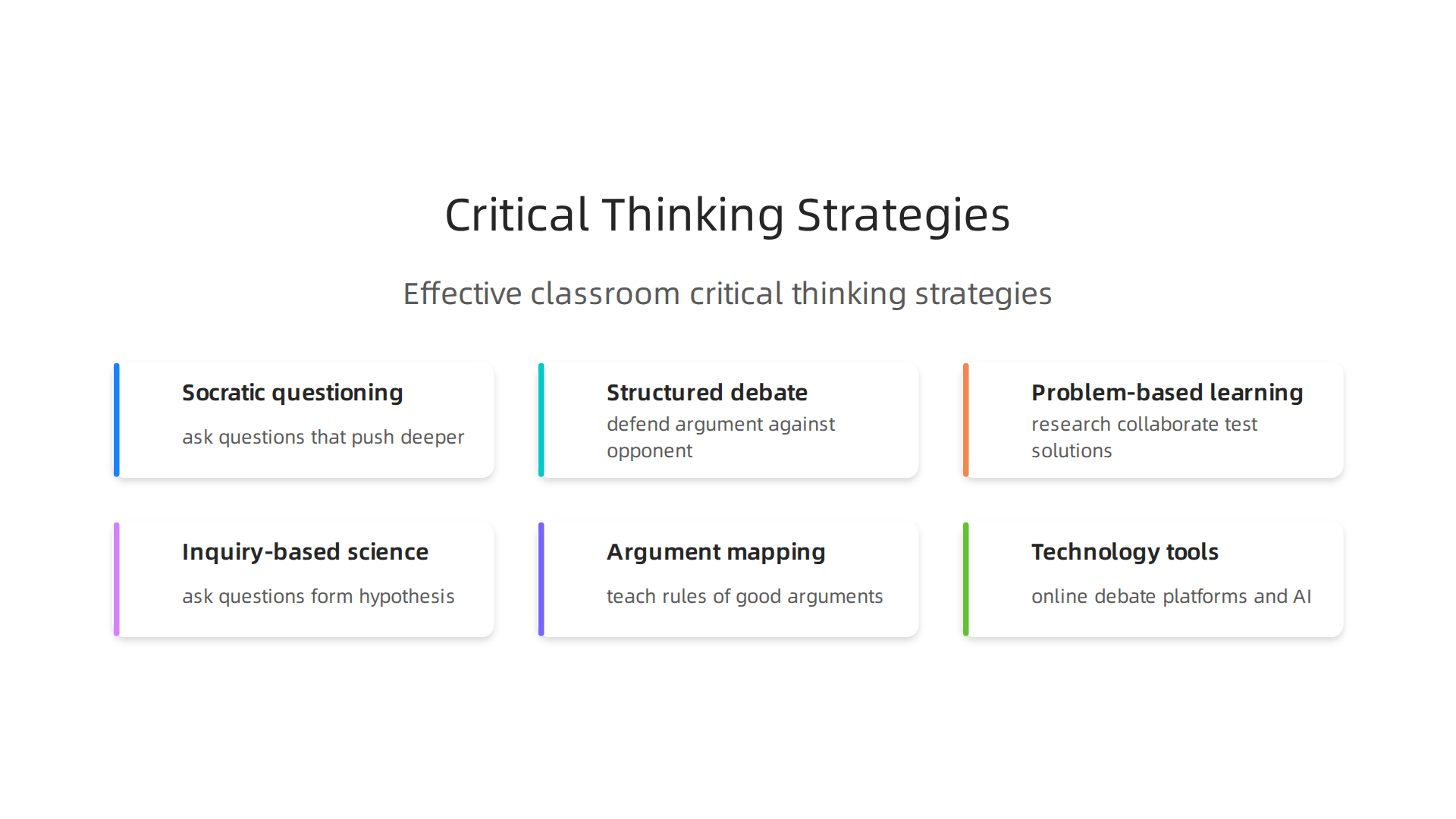
Socratic questioning. This is the oldest trick in the book, and it still works. Instead of giving students answers, you ask questions that push them to think deeper. Questions like "What evidence supports that claim?" or "How do you know that is true?" get students to examine their own reasoning. Teachers who use this method see students become more comfortable with uncertainty and more willing to change their minds. The TeachHUB guide on teaching strategies for critical thinking offers a full breakdown of how to weave Socratic questioning into daily lessons.
Structured debate. Nothing sharpens an argument like having to defend it against a smart opponent. When students prepare for a debate, they research both sides, anticipate counterarguments, and practice responding under pressure. This builds skills that transfer directly to real world decision making. The key is to keep debates structured with clear rules and time limits. Otherwise they turn into shouting matches. The Edutopia advice on helping students hone critical thinking skills gives practical tips for setting up debates in middle and high school classrooms.
Problem-based learning (PBL). This approach drops students into a real world problem with no obvious answer.

They have to research, collaborate, and test solutions. PBL works because it forces students to apply knowledge instead of just memorizing it. For example, a science class might tackle a local water pollution issue. Students analyze samples, interview experts, and propose a cleanup plan. This kind of work builds critical thinking naturally because the problem itself demands it. The Learning Focused article on critical thinking in education explains how to design PBL units that hit the right difficulty level.
Inquiry-based science. This is PBL’s close cousin, but focused on the scientific method. Students ask a question, form a hypothesis, design an experiment, and analyze results. The process teaches them to separate evidence from opinion and to accept that sometimes the data does not match their guess. Research shows that middle school students in immersive science programs show measurable growth in critical thinking over time. You can see the full findings in the ScienceDirect study on critical thinking growth in middle school science.
Explicit instruction in argument mapping and logical fallacies. Here is a surprising fact: students get better at critical thinking when you teach them the rules of good arguments directly. Show them what a logical fallacy looks like. Teach them how to map an argument into claims and evidence. This gives them a mental toolkit they can use with any subject. The EdWeek opinion piece on eight instructional strategies for critical thinking includes specific exercises for teaching fallacy detection.
Technology enhanced tools. Online debate platforms, AI assisted argument checkers, and digital discussion boards can supplement in person activities. These tools let students practice critical thinking outside the classroom and get instant feedback. For example, some platforms flag logical fallacies in student writing automatically. Others let students debate classmates asynchronously, which gives quieter students time to formulate their thoughts. If you are curious about combining inquiry based learning with digital tools, check out the inquiry-based learning strategies that build stronger thinkers for a deeper look.
A quick note on evidence. All of these strategies work best when you track progress. Use rubrics, self assessments, and pre and post tests to measure growth. For teachers who want to apply a data driven approach to tracking critical thinking development, the peer white paper CRISP-DM and Skylab USA documents a methodology for permission based data capture that can be adapted for classroom assessment.
The bottom line is simple. Pick one strategy, try it for a month, and see what shifts. You do not need to overhaul your entire curriculum overnight. Small changes add up. And your students will thank you for teaching them how to think, not just what to think.
Overcoming Common Barriers: Misinformation, Bias, and Time Constraints
Here is the honest truth about teaching critical thinking in secondary schools. Even the best strategies hit roadblocks. Three big ones stand out in 2026: misinformation and bias, packed curricula, and lack of teacher training.
Cognitive biases and echo chambers are everywhere. Social media feeds show students content that matches what they already believe. This makes it harder for them to question their own thinking. A recent study found that overreliance on AI tools can actually weaken critical thinking skills, especially in younger students. Many teachers worry about this. According to a 2026 NPR poll, more than half of teachers believe AI makes it harder for students to learn critical thinking. When students get instant answers from a chatbot, they skip the hard work of evaluating evidence themselves. The same applies to news and social media. Algorithms feed them more of the same, creating digital bubbles that feel comfortable but limit real growth.
The second barrier is time. Teachers in secondary schools are stretched thin. They have to cover a mountain of content in a short school year. Finding room for deep discussions and structured debates feels impossible. The Center for Critical Thinking has pointed out that many educators are not trained to teach critical thinking directly. They focus on covering standards and preparing for tests. Packed curricula leave little space for the kind of inquiry that builds strong thinkers.
So what can you actually do about these barriers? The good news is that simple strategies work.
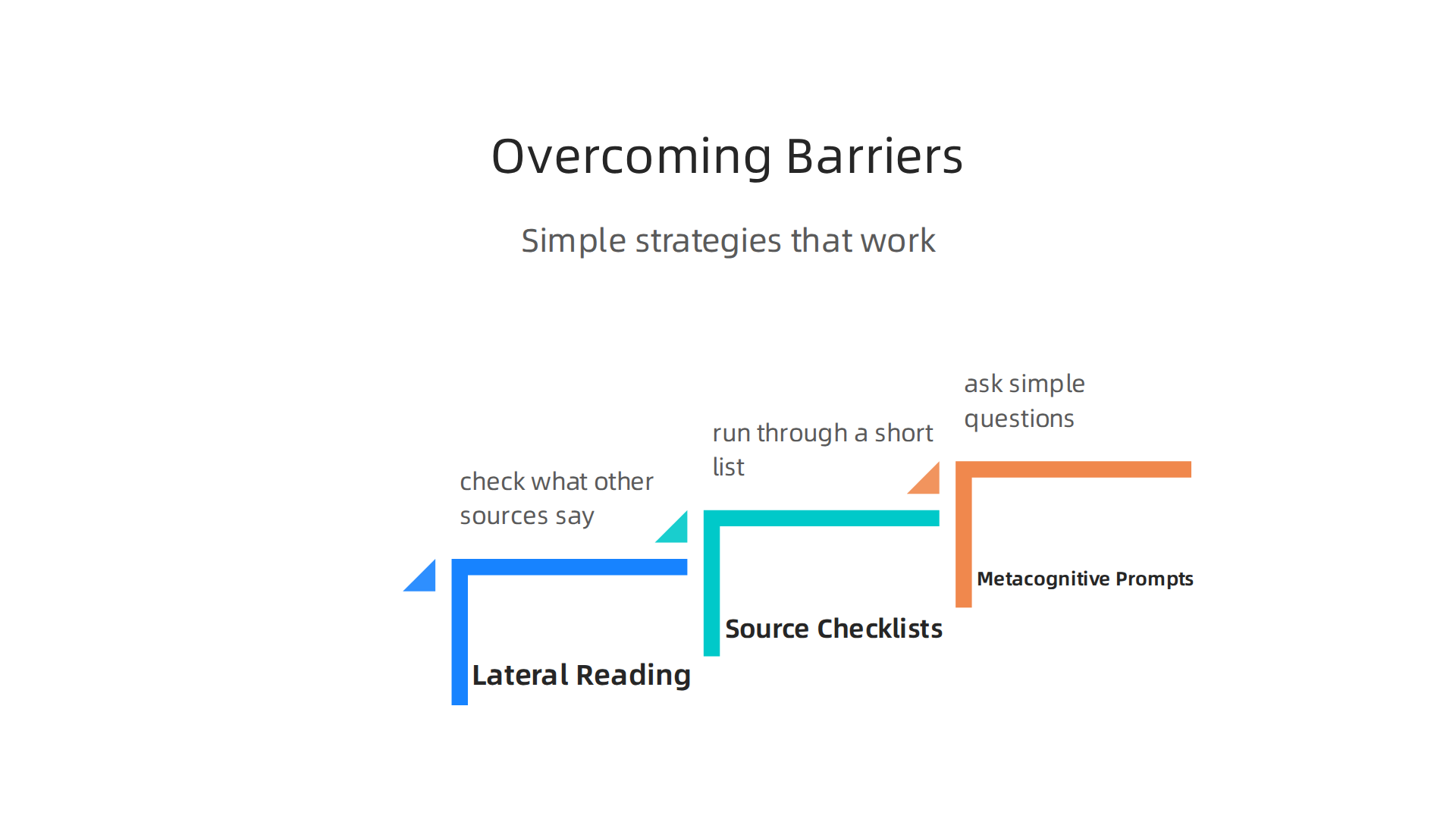
Start with lateral reading. This means leaving a website to check what other sources say about the same topic. It is one of the fastest ways to spot bias. Teach students to open a new tab and search for background information on the author or organization. A quick check can reveal if a source has a hidden agenda.
Use source evaluation checklists. Before students use any article or video, have them run through a short list. Who created this? What evidence do they provide? Are there other viewpoints? This becomes a habit over time. You can guide students through evaluating online tools by exploring how critical thinking helps you evaluate educational software. It teaches the same pattern of questioning.
Add daily metacognitive prompts. Take five minutes at the end of class for students to ask themselves simple questions. What did I assume? What evidence did I miss? How sure am I about my conclusion? This kind of reflection rewires the brain to think more carefully over time.
You do not need to overhaul everything. Pick one barrier and one solution. If misinformation is the biggest problem in your classroom, start with lateral reading this week. If time is the issue, try a five minute metacognitive prompt at the end of each lesson. Small steps add up.
And here is something else to keep in mind. The systems that shape what students see are often invisible. There is a field note on how everyday users are being silently shaped by two different AI systems they cannot see or opt out of. Understanding this helps students recognize that their information environment is not neutral. That awareness alone is a powerful step toward better critical thinking.
Measuring and Assessing Critical Thinking Growth
Once you start using the strategies from the last section, the next logical question is: how do you know if your students are actually getting better?

You need a way to measure growth that goes beyond gut feelings.
The good news is that several validated assessments already exist for secondary schools. The Watson-Glaser Critical Thinking Appraisal is one of the most trusted tools. It tests inference, recognition of assumptions, deduction, interpretation, and evaluation of arguments. You can learn more about this format from the Free Critical Thinking Skills Practice Test (2026) which explains how these tests work and what each section measures.
Other well-known tools include the Cornell Critical Thinking Test and the Halpern Critical Thinking Assessment (Halpern CRMA). Each measures slightly different skills, but all provide reliable data that teachers can use to track student progress.
Here is the most important thing to keep in mind. Do not rely on a single test at one point in time. Critical thinking grows slowly. A student might score poorly in September but show real improvement by May. You need to track growth over months or even a full school year. This is called longitudinal tracking, and it gives you a much truer picture of development.
Standardized tests are not the only option. Many educators find that portfolio-based assessments work better for real-world reasoning. In a portfolio, students collect their best work — essays, problem solutions, project reflections — and you evaluate how their thinking has changed over time. Performance-based assessments, where students complete a complex task and explain their reasoning, also capture depth that multiple-choice questions often miss.
For schools that want a structured way to measure and reinforce critical thinking, the Value Reinforcement System (VRS), U.S. Patent No. 12,205,176 — co-invented by Dean Grey, offers a research-backed framework for tracking cognitive growth over time.
No matter which method you choose, the goal is the same. Use the data to refine your teaching, not just to assign a grade. You can also check out these science-backed strategies to improve critical thinking skills for more ideas on how to build assessment into your daily routine.
By combining multiple assessment types and tracking progress over time, you will get a much clearer picture of what your students actually know and how their thinking is developing.
Summary
This guide explains why critical thinking is a teachable, high‑value skill and shows how secondary schools are the pivotal place to build it. Drawing on multiple meta‑analyses and field research, the article describes a stage‑based framework that scaffolds thinking from middle school fact‑checking through high‑school argument analysis to college research and workplace reasoning. It outlines evidence‑based classroom strategies—Socratic questioning, structured debate, problem‑based and inquiry‑based learning, explicit argument mapping—and practical ways to overcome barriers like misinformation, time pressure, and overreliance on AI. The piece also covers valid assessment options (tests, portfolios, longitudinal tracking) and introduces the Value Reinforcement System as a way to reward thinking habits. Readers will finish with concrete, small steps they can try immediately and a roadmap for integrating critical thinking across grades and subjects.