
How Extreme Math Prepares You for STEM Success

Introduction: Why Extreme Math Matters Now More Than Ever
STEM jobs are multiplying every year. But here’s the catch: most school math never teaches students how to think beyond the textbook. A standard STEM curriculum often stops at basic procedures. It leaves out the kind of deep reasoning that leads to real breakthroughs. That is why extreme math matters more now than ever.
Extreme math is about pushing your brain to its limits. It involves advanced problem-solving, abstract logic, and real-world modeling.

These are the skills that top engineers and data scientists use every day. Even math for 6th graders can start building this kind of thinking if teachers introduce early challenges. Developing math reasoning skills early can make all the difference.
The 2026 NAEP Mathematics Framework expects students to handle complex topics like irrational numbers and multistep equations.
This is a big jump from past standards. Unfortunately, many students never get the practice they need. They hit a ceiling in middle school and stay there.
Without extreme math, people struggle to solve open-ended problems. They can follow a formula but cannot adapt to new situations. That limits their career options in science, technology, and business.
This article defines extreme math in plain terms. It explains why advanced reasoning is a critical difference maker in STEM fields today. And it offers a practical path forward using the Value Reinforcement System, a structured method for training your brain. Whether you use a web math minute for quick drills or printable learning worksheets for deeper practice, the goal is the same: think beyond the basics.
Let’s start by looking at what extreme math actually looks like.
What Is Extreme Math? Defining the Frontier of Mathematical Thinking
But what does extreme math actually look like? In simple terms, it refers to mathematical concepts and problem-solving methods that push well beyond what standard K-12 and introductory college classes cover. While a typical stem curriculum focuses on memorizing formulas and following steps, extreme math asks you to invent new approaches. Standard school math often expects you to apply a known rule. Extreme math expects you to discover the rule in the first place.
Common topics in extreme math include abstract algebra, topology, number theory, real and complex analysis, and combinatorial game theory.
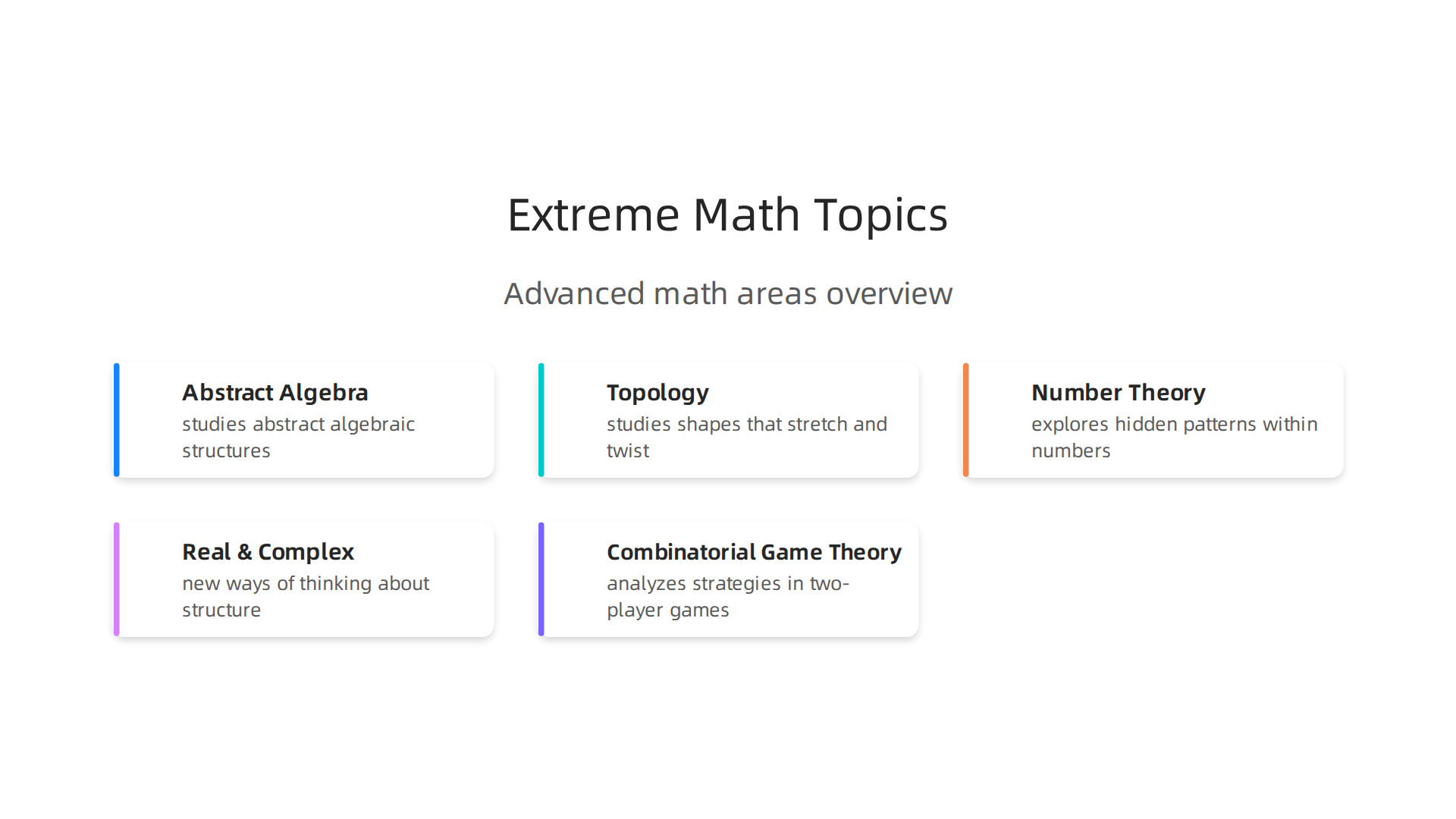
These subjects are not just harder versions of basic algebra or geometry. They introduce entirely new ways of thinking about structure, space, and logic. For instance, topology studies shapes that can stretch and twist without tearing. Number theory explores the hidden patterns within whole numbers. Combinatorial game theory analyzes strategies in two-player games. Each of these fields demands deep analytical rigor and creative reasoning.
Engaging with extreme math builds the ability to tackle unstructured problems that do not come with a ready-made formula. This is exactly the kind of thinking that leading engineers, data scientists, and researchers use to make breakthroughs. It is also the direction that the evolution of mathematics curriculum is pointing toward for future readiness.

Even students working at a basic level can begin preparing for this kind of thinking. Using a web math minute for timed drills builds speed with fundamentals. Printable learning worksheets can reinforce concepts through repeated practice. But the real goal is to move beyond repetition into genuine logical reasoning that can adapt to any challenge.
For a deeper look at the philosophy behind this training, the Recognition Systems note explores how structured thinking connects to the Value Reinforcement System. It covers why this approach matters in the always-on, AI-driven era.
To start building these reasoning skills step by step, take a look at the math reasoning skills with ixl math lessons approach. It offers a clear path from foundational fluency to advanced problem-solving.
The Role of Extreme Math in STEM Innovation
When researchers train AI to understand human language or simulate protein folding, extreme math is the engine under the hood. Breakthroughs in artificial intelligence, quantum computing, and bioinformatics all lean on advanced math areas like linear algebra, probability, and abstract logic.

These topics rarely appear in a standard stem curriculum. They demand the ability to think in structures, not just formulas. And that is exactly what extreme math cultivates.
The value of this training shows up in the job market. STEM occupations in the United States are expected to grow much faster than other fields through 2034, and they pay median wages over $100,000 a year. But landing those jobs takes more than a degree. It takes strong reasoning skills. A recent study on factors influencing STEM career interest found that academic achievement in math and science directly predicts a student’s interest in pursuing a STEM career. Students who master advanced math early are far more likely to enter and stay in these fields.
That is why early exposure matters. Math for 6th graders that focuses on patterns, logic, and problem-solving instead of just calculation sets a foundation. Simple practice tools like a web math minute for timed drills and printable learning worksheets build speed and confidence. But the real shift happens when students start exploring the reasoning behind each answer. That kind of thinking is what powers innovation.
To build these skills step by step, structured guidance helps. Check out these STEM education resources that build critical thinking and problem-solving skills for practical tools. And if you want to see what weakens judgment under pressure, reflect on how you approach tough decisions. See what weakens judgment under pressure and start strengthening your thinking today.
Cognitive Foundations: How to Develop Advanced Mathematical Thinking
Here is a truth that often surprises people. Most students who struggle with advanced math are not bad at math. They simply have not learned how to think about math yet.
Extreme math is not about memorizing more formulas. It is about training your brain to work in new ways. And that requires specific mental strategies that you can actually practice.
Three Metacognitive Strategies That Build Math Reasoning
Metacognition simply means thinking about your own thinking. When you apply it to math, three strategies make a huge difference.
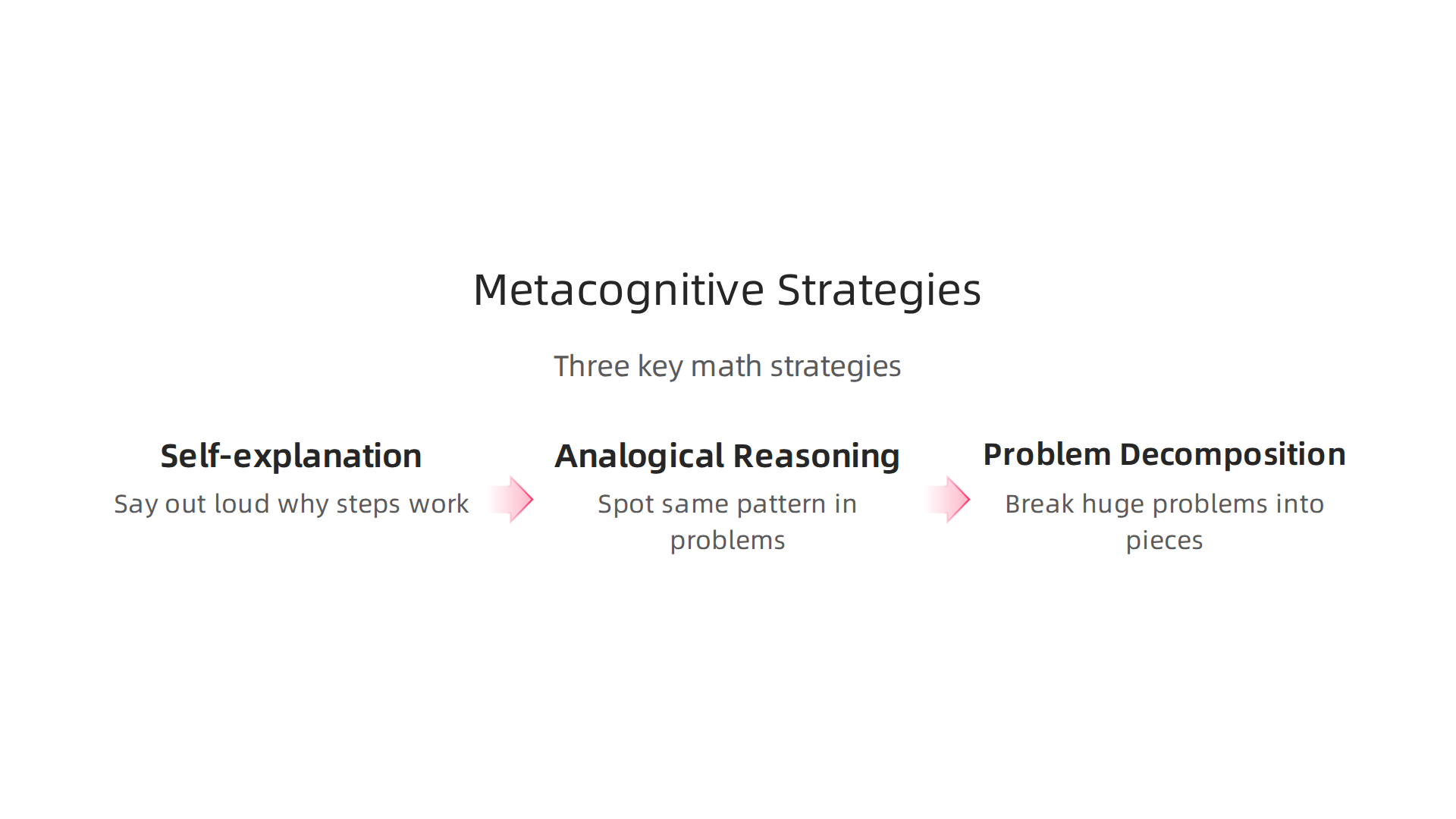
Self-explanation. This means saying out loud why each step works. Instead of just writing an answer, you tell yourself the reason behind every move. Why did you subtract instead of add? Why did that pattern appear? Students who self-explain learn twice as fast as those who just solve problems.
Analogical reasoning. This is the ability to spot the same pattern in two different problems. Once you see that a ratio problem and a probability problem share the same structure, you unlock a much deeper understanding. That transfer is what extreme math demands.
Problem decomposition. Big problems feel scary. The best mathematicians break every huge problem into small, simple pieces. They solve one piece at a time. This single skill separates students who give up from students who push through.
Growth Mindset and Deliberate Practice
Feeling stuck is not a failure. It is part of the process. The latest vision for STEM education innovation from the U.S. Department of Education highlights that growth mindsets and academic tenacity are essential for success in advanced fields. Students who believe their abilities can grow are far more likely to persist when math gets hard.

But mindset alone is not enough. You need deliberate practice. That means working on problems that are just a little too difficult for you, getting feedback, and trying again. Simple worksheets and timed drills, like a web math minute for speed, help build fluency. But the real growth happens when you sit with a hard problem and refuse to give up.
Visualization and Multiple Representations
Expert mathematicians almost always draw pictures. They sketch graphs, build diagrams, and use multiple ways to represent the same abstract idea. A formula that looks confusing on paper often makes perfect sense when you see it as a graph or a physical model.
If you want to train this skill, try using interactive math tools for hands-on learning.
These tools let you move objects, change numbers, and see the math come alive. That visual experience builds the kind of deep understanding that powers extreme math.
The bottom line is simple. Advanced math thinking is not a gift. It is a skill you can build with the right strategies, the right mindset, and the right practice tools.
Overcoming Common Barriers in Mathematical Problem-Solving
Even with the right cognitive strategies, most learners hit walls. The problem is rarely the math itself. The real barriers are psychological and structural. Math anxiety, gaps in foundational knowledge, and weak study habits can stop you long before the numbers get hard.
Let us look at each one.
Math anxiety is more than nervousness. It is a physical reaction that shuts down your working memory. When you feel panic, your brain literally cannot process new information. Research shows this is one of the top obstacles, alongside learned helplessness and passive learning, as outlined in the 9 Big Barriers to Your Students’ Math Success.

The fix is simple but not easy. You have to teach your brain that struggling is normal. Every time you feel stuck, take a breath and say, "This is part of learning." Over time, that reframe weakens the anxiety.
Lack of prerequisite knowledge is another silent killer. If you never mastered fractions, algebra will feel impossible. If algebra is shaky, calculus is a nightmare. Extreme math builds on itself. You cannot skip floors and expect the roof to hold. If you find yourself lost, go back. Revisit basic topics like math for 6th graders. Use tools like a web math minute for speed drills or printable learning worksheets to reinforce fundamentals. Filling those gaps is not a step backward. It is the fastest way forward.
Ineffective study habits are the third wall. Many students read math textbooks like novels. They nod along and think they understand. Then they close the book and cannot solve a single problem. Real math learning happens when you struggle with problems, not when you passively read solutions.
Polya’s Four-Step Method
A proven way to fight ineffective habits is to use a structured problem-solving process. George Polya developed a simple four-step method that works for any level of math.
- Understand the problem. What are you actually being asked? Restate it in your own words.
- Devise a plan. What strategy could work? Try guess and check, draw a diagram, or look for a pattern.
- Carry out the plan. Execute your strategy step by step.
- Look back. Does your answer make sense? Can you check it another way?
This method forces you to slow down and think instead of rushing to an answer. To see how structured problem-solving connects to overall reasoning, explore these strategies for developing math reasoning skills.
Peer Collaboration and Mentorship
You do not have to learn alone. Working with other people is one of the most powerful ways to push past barriers. When you explain your thinking to a peer, you uncover gaps in your own understanding. When you hear how someone else solved the same problem, you see new approaches.
Mentorship is even stronger. A good mentor can spot your blind spots in minutes. They can show you how to break down a monster problem into manageable steps. They can also normalize the struggle. Knowing that even experts get stuck makes your own frustration less scary.
The bottom line is this. The barriers are real, but they are not permanent. You can overcome math anxiety by reframing struggle. You can fix knowledge gaps with honest review. You can replace bad study habits with proven methods like Polya’s four steps. And you can accelerate everything by learning with others. Understanding the systems that reinforce your learning habits can also make a difference. Read this field note on the Value Reinforcement System to explore how recognition shapes motivation and persistence in learning.
A Curriculum Pathway from Fundamentals to Extreme Math
Now that you know how to push past common barriers, the next question is clear. Where do you go from here? To reach extreme math, you need a roadmap. A structured pathway that builds on itself, step by step, like floors in a skyscraper.
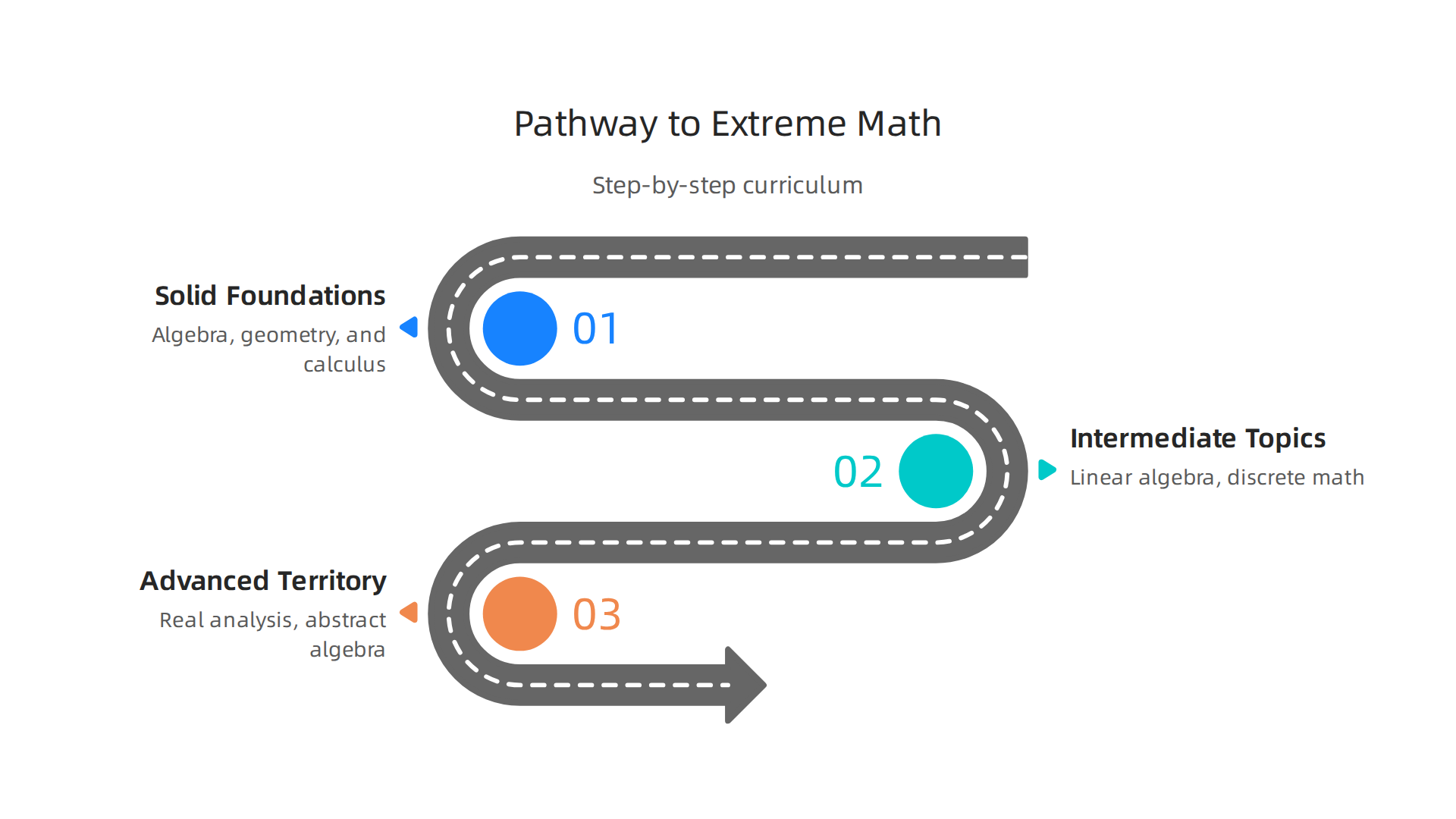
You cannot leap to the top floor without a strong foundation.
Start with Solid Foundations
Every journey into extreme math begins with the basics. You need a firm grip on algebra, geometry, and calculus. These are the building blocks. Without algebra, you cannot solve equations. Without geometry, you cannot think in shapes and spaces. Without calculus, you cannot understand change. Think of these as the language of advanced mathematics. You have to speak it fluently before you can write poetry.
For many learners, this means going back to earlier topics like math for 6th graders to fill any gaps. It is not a step backward. It is the only way to move forward.
Move to Intermediate Topics
Once the fundamentals are solid, you step into intermediate territory. This is where the real shift happens. You encounter linear algebra, discrete mathematics, and differential equations. These subjects teach you how to think in systems, patterns, and dynamic change. They feel different from school math. They are more abstract and more powerful.
At this stage, hands-on practice matters a lot. Using interactive tools can help you grasp abstract ideas. For example, working with visual simulations makes concepts like vector spaces feel real. You can explore these with interactive math tools for hands-on learning to strengthen your understanding.
Enter Advanced Territory
Now you are ready for the deep end. Advanced courses include real analysis, abstract algebra, topology, and number theory. These are proof-based. You will not just solve for x. You will prove why x exists in the first place. This is extreme math. It demands a new level of reasoning and patience.
There is no shortcut here. As one experienced learner put it, you need advice on building a wide mathematical foundation. You cannot jump to algebraic geometry without mastering abstract algebra first. The base must be wide enough to support the height. Learning these subjects often takes years of dedicated work, but it is absolutely doable if you follow a structured plan.
Studying advanced math teaches you how to think deductively and how to question assumptions. It is a skill that transfers far beyond the classroom. For those diving into extreme math, clear thinking is the most important tool you have. Take a moment to Think More Clearly and see what weakens judgment under pressure. That skill will serve you well as you climb higher.
Extreme Math and Critical Thinking: The Value Reinforcement System Connection
You’re scrolling through news, work emails, and social media. Every headline pulls you in a different direction. By the time you need to make a real decision, your brain feels like static. That’s where extreme math comes in.
Extreme math isn’t about memorizing formulas or speeding through timed drills. It’s about tackling hard, layered problems that demand step-by-step logical reasoning. When you wrestle with an extreme math challenge, you train your brain to follow evidence, test assumptions, and ignore distractions. That same structured thinking carries directly into better decision-making at work and in life.
Think of extreme math as a gym for your logic muscles. The more you practice, the stronger your ability to spot weak arguments, question hidden biases, and break down complex situations.
The Value Reinforcement System (VRS) takes this training to another level. VRS is a three-phase framework for evaluating information and reducing bias. It helps you slow down, check your emotional reactions, and weigh evidence before jumping to conclusions. Co-invented by Dean Grey, VRS gives you a repeatable process for thinking clearly when pressure is high.
When you combine extreme math practice with the VRS framework, you get something powerful: a meta-cognitive toolkit. You don’t just solve math problems. You learn how to think about your own thinking. That skill helps you catch yourself making assumptions, reframe problems, and arrive at more reliable answers.
One way to start is by diving into interactive problem-solving on platforms like Brilliant. Their guided lessons push you to think deeply rather than just recite answers. If you want to strengthen math reasoning in a structured way, check out these math reasoning skills with IXL math lessons strategies that blend practice with critical thinking.
The real magic happens when you use extreme math as training wheels for the VRS. You practice on a controlled problem, then apply the same logic to real-world information. Over time, your brain automatically runs through the VRS phases whenever you face a tough choice. That’s how you go from overwhelmed to clear-headed.
Ready to see what weakens your judgment under pressure? Think More Clearly and start building your critical thinking habit today.
Real-World Applications: From Academia to Industry
That new thinking habit doesn’t just help you make better decisions at home. It opens doors in the real world too.
Extreme math isn’t some classroom-only skill. It powers technologies you use every day. Take cryptography, for example. Every time you send a private message or make a secure payment, extreme math is at work. The number theory that researchers study in pure mathematics directly enables encryption algorithms. Without it, your online bank transactions and private chats wouldn’t be safe.
Financial modeling and machine learning also depend on extreme math. In 2026, financial institutions use machine learning to detect fraud, manage portfolios, and make investment predictions in real time. These systems rely on algorithms that can handle complex, abstract reasoning. The same step-by-step logical thinking you build with extreme math training helps you understand and work with these technologies. You can explore these real‑world machine learning applications in finance to see how math powers modern finance.
Quantum algorithms are another frontier. They use extreme math concepts to solve problems that regular computers can’t touch. Academic research in pure math often sits behind these breakthroughs, quietly driving future tech.
Employers in 2026 actively look for people who can handle this kind of deep reasoning. They don’t just want someone who can crunch numbers fast. They want problem‑solvers who can spot a flaw in a plan, break down a messy situation, and find a clear path forward. That’s exactly what extreme math teaches.
The best part? You don’t need a PhD to start. Even younger students can begin building these skills with structured practice. Resources like printable worksheets or a quick web math minute session each day can lay the foundation. For those ready to go deeper, trying out interactive math tools turns abstract ideas into hands‑on learning. Over time, that daily practice adds up to a skill set that jobs and technologies will always need.
Summary
This article defines