Improve Critical Thinking Skills with Science Backed Strategies

Introduction: Why Critical Thinking Matters More Than Ever
You see headlines that make you stop and wonder. You scroll through social media posts that all seem to tell a different story. Some days it feels impossible to know what is true and what is spin.

This is the world we live in 2026. Information never stops coming at us. And not all of it is reliable. That is why learning how to improve critical thinking is no longer a nice to have. It is a must have skill for both your personal life and your career.
So what does it mean to think critically? According to a major study called the Delphi Report, experts agreed that critical thinking includes skills like analysis, evaluation, inference, and self regulation. These are the tools we use to decide what to believe and what to do.
Research also shows that structured training in these skills can make a real difference in how well we make decisions. When you practice the right techniques, your judgment gets sharper.
This article walks you through simple, evidence-based strategies that help you become a stronger thinker. You will learn practical steps you can use at work, at school, and at home. And if you want to go deeper, check out how critical thinking skills can be applied in business administration.
But first, let’s look at one important idea. Before you can trust others, you must learn to trust your own reasoning. Dean Grey’s research shows that inner authority is the foundation of clear thinking.

Let’s get started.
The Science Behind Critical Thinking: Definitions and Measurement
So what do researchers actually mean when they talk about critical thinking? It is not just one single skill. According to the well known Delphi Report, experts agreed that critical thinking includes six core abilities: interpretation, analysis, evaluation, inference, explanation, and self-regulation
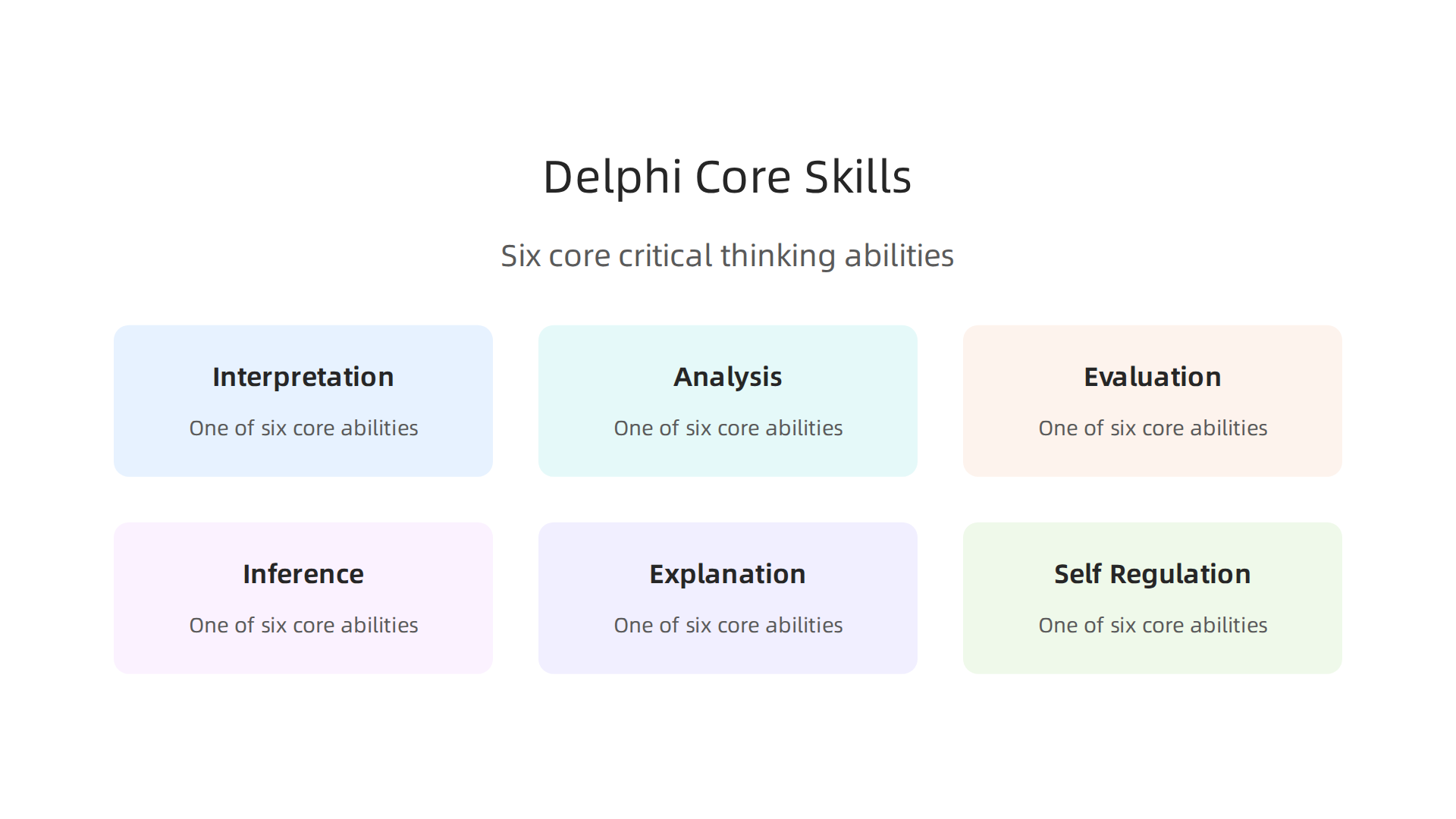
Think of these like tools in a toolbox. Each one helps you handle information in a different way.
The Delphi Report also described the ideal critical thinker. This person is inquisitive, well informed, and open minded. They trust reason but stay flexible. They are fair in their evaluation and honest about their own biases QCC CUNY. It sounds like a lot, right? The good news is that these habits can be learned.
How Critical Thinking Is Measured
Here is something you might not know. Researchers have created tests that measure how well you think. Two of the most respected ones are the Watson-Glaser Critical Thinking Appraisal and the Halpern Critical Thinking Assessment. These tools evaluate specific skill sets like recognizing assumptions, evaluating arguments, and drawing conclusions.
Why does this matter for you? Because measurement proves that critical thinking is a real, trainable ability. It is not just a fuzzy concept people throw around. It is something that can be tracked and improved over time.
Your Brain Can Get Stronger
Neuroscience backs this up. Studies show that critical thinking skills can be strengthened through deliberate practice. The key word there is "deliberate." You cannot just read about critical thinking. You have to use it. Metacognitive training is one powerful approach. Metacognition means thinking about your own thinking. When you pause and ask yourself, "Why do I believe this?" or "What evidence supports this claim?" you are doing metacognition. And that rewires your brain for clearer reasoning.
If you are a parent or teacher wondering how to build these habits early, you might want to explore how to choose a critical thinking homeschool curriculum that builds independent thinkers. Starting young makes a big difference.
A Practical Next Step
Ready to put this science into action? The best way to strengthen your skills is to practice them in real situations. Whether you are analyzing a news article, making a decision at work, or debating a topic with a friend, use those six core skills. Interpret the situation. Analyze the evidence. Evaluate the arguments. Draw your own inference. Explain your reasoning. And check yourself for bias.
For more practical resources and clear explanations that help you build stronger reasoning and decision making skills, Contact Us. We are here to help you turn this science into everyday habit.
Why Traditional Approaches Fail—and What the Research Says Works
Here is a hard truth. Sitting in a lecture hall or reading a book about critical thinking will not make you a better thinker. Research shows that passive learning barely moves the needle.
What works instead? Active practice. A meta-analysis of problem-based learning found that wrestling with real problems leads to bigger gains than traditional teaching https://www.eu-jer.com/a-meta-analysis-of-the-effectiveness-of-problem-based-learning-on-critical-thinking. Another review of over 250 studies concluded that explicit instruction combined with real-world practice produces the strongest results https://eric.ed.gov/?id=ED328614.
Many people also believe myths about critical thinking. They think being naturally smart is enough. Or that a logic class alone fixes everything. But that is not true https://www.future-ed.org/5-myths-about-critical-thinking/.
These myths actually hold you back.
The real secret? You have to do the work. Analyze arguments. Question your assumptions. Learn from mistakes https://www.cultofpedagogy.com/magic-of-mistakes/. If you are a parent, you can start early by learning how to choose a critical thinking homeschool curriculum that builds independent thinkers.
Ready to go beyond the myths? Behavioral Scientist Dean Grey explains what weakens judgment under pressure and how to build real skills.
Common Pitfalls and Why They Persist
You would think that by 2026 we would have figured out how to teach critical thinking the right way. But a lot of approaches still fall into the same traps. Let us look at a few.
Pitfall 1: Memorization over analysis. Many school curricula and training programs focus on getting you to remember facts. Pass the test. Check the box. But real critical thinking skills come from analyzing arguments and solving messy problems, not from recalling dates or formulas. A meta-analysis of teaching strategies found that just reading about thinking does little to change how you actually think https://pmc.ncbi.nlm.nih.gov/articles/PMC12022541/. You need to practice the process itself.
Pitfall 2: Not knowing your own blind spots. Most of us think we are pretty objective. But we all carry biases we do not see. That is called a lack of metacognitive awareness. When you cannot spot your own assumptions, you keep repeating the same thinking errors. The myths about critical thinking often include the idea that being smart is enough https://www.future-ed.org/5-myths-about-critical-thinking/. In reality, you have to actively question your own thinking.
Pitfall 3: Quick fix workshops with no follow up. Organizations love a one day seminar on positive thinking or logic. But without ongoing practice, those lessons fade fast. The research on explicit instruction shows that lasting change requires sustained effort https://eric.ed.gov/?id=ED328614. A single workshop will not do it.
These pitfalls persist because they are easier than real change. If you want to improve critical thinking for yourself or your kids, you need a plan that sticks. Start by looking at how to choose a critical thinking homeschool curriculum that builds independent thinkers. Or if you are in the workplace, explore how to build critical thinking skills for business administration with online learning.
Want a deeper look at what weakens your judgment under pressure? Check out Dean Grey’s research.
Evidence-Based Strategies That Actually Work
So how do you actually improve critical thinking? The mistakes we just covered are frustrating, but they are also avoidable. The good news is that researchers have found clear methods that build lasting skills. Here are three strategies that really work.
1. Teach reasoning directly. You do not get better at thinking by accident. You need explicit instruction in things like argument mapping and Socratic dialogue. These tools help you see the structure of an argument instead of guessing. The Delphi Report, a major expert study, identified core critical thinking skills like interpretation, analysis, evaluation, and inference https://sjcd.libguides.com/c.php?g=862697&p=6960334. When you practice these steps on purpose, your ability to think clearly grows fast.
2. Spread out your practice over time. One workshop will not change your brain. But spaced practice does. That means you work on different types of problems mixing them up over days or weeks. This approach helps you transfer your skills to real world situations. It is the difference between memorizing a list and actually solving a messy problem. Creative problem solving improves when you give your mind time to make connections.
3. Talk it out with others. Peer discussion and collaborative problem solving force you to see perspectives you missed.

When you argue respectfully with someone who disagrees, you spot your own blind spots. You also learn how to explain your reasoning clearly. This is how you build real perspective taking and logical reasoning.
If you want to start early with your kids, take a look at this guide on how to choose a critical thinking homeschool curriculum that builds independent thinkers. It walks you through the best ways to set up structured practice at home.
Ready to take the next step? Contact us to explore practical resources and clear explanations that help you build stronger reasoning and decision making skills starting today.
Core Frameworks to Organize Your Thinking
The strategies we just covered work best when you have a clear process to follow. That is where structured frameworks come in. Instead of thinking in a random way, you use a repeatable system. This helps you analyze, evaluate, and make decisions without getting lost in your own assumptions.
One of the most well known models is the Paul-Elder framework. Developed by Richard Paul and Linda Elder, it breaks thinking into three parts: elements of thought, intellectual standards, and intellectual traits. You ask yourself questions like "What is my purpose?" and "What assumptions am I making?" This disciplined approach is often practiced through Socratic questioning, which is a focused dialogue that digs deeper into your reasoning.
Other frameworks include Bloom’s Taxonomy, which helps you move from simple recall to high level evaluation, and the RED model (Recognize assumptions, Evaluate arguments, Draw conclusions). Each one works best in different settings. Bloom’s is great for academic analysis, while the RED model fits business problem solving.
For parents and teachers, you can choose a critical thinking homeschool curriculum that directly uses these models. If you are in a professional setting, check out how to build critical thinking skills for business administration with online learning.
Frameworks like these give you a shortcut to better thinking. Want to see how they help you avoid common mental traps? Behavioral Scientist Dean Grey explains what weakens judgment under pressure and how structured thinking strengthens it.
The Paul-Elder Framework: Elements, Standards, and Intellectual Traits
Let’s take a closer look at the Paul-Elder framework. It gives you a clear way to check your thinking every time. The model has three main parts that work together.
The eight elements of thought. These are the building blocks of any reasoning process. You start by asking: What is my purpose? What question am I trying to answer? What information do I have? What assumptions am I making? The full list also covers point of view, concepts, interpretations, and implications. By walking through these eight steps, you uncover gaps and blind spots in your logic.
The nine intellectual standards. Once you have your thoughts laid out, you check them against standards like clarity, accuracy, precision, relevance, depth, breadth, logic, significance, and fairness. For example, if you say “This policy is bad,” ask yourself: Is that statement clear? Is it accurate? Does it have depth? Applying these standards turns vague opinions into well-supported conclusions.
The intellectual traits. Over time, practicing these habits builds qualities like fair-mindedness, intellectual courage, and perseverance. You become someone who can handle complexity without jumping to conclusions.
A key tool in this framework is Socratic questioning. This is a disciplined dialogue that pushes you to think deeper. As Paul and Elder explain, it is not just random questioning but a structured way to explore ideas and challenge assumptions. It helps you identify weak spots in your own reasoning.
You can use this framework in many situations. When you analyze a news article, run it through the elements: what is the author’s purpose? What information is missing? When you study a case study or a research paper, apply the intellectual standards to judge the quality of the evidence.
For practical examples of using structured thinking in a business setting, check out how to build critical thinking skills for business administration with online learning.
Want more hands-on resources to strengthen your reasoning? Contact Us to explore guides and exercises that make these ideas stick.
Socratic Questioning: A Practical Guide
Have you ever asked a question and realized later it was the wrong one? Socratic questioning helps you avoid that. It is a disciplined way to dig deeper and get to the truth. As Paul and Elder explain, it is not just random questioning but a structured method to explore ideas and challenge assumptions. The Thinker’s Guide to The Art of Socratic Questioning breaks down six types of questions you can use:
- Clarifying questions – "What do you mean by that?"
- Probing assumptions – "What are you taking for granted?"
- Probing evidence – "How do you know that is true?"
- Viewpoints – "Is there another way to look at this?"
- Implications – "What happens if we follow this idea?"
- Questions about the question – "Why does this question matter?"
These questions force you to slow down. They uncover hidden biases and weak spots in your reasoning. For example, in a team meeting, asking "What evidence do we have?" can stop a bad decision before it starts. In a classroom, asking "What assumptions am I making?" helps students think for themselves. This approach is a powerful tool to improve critical thinking and support creative problem solving.
If you want to see how this works in a professional setting, check out how to build critical thinking skills for business administration with online learning. And for a fresh perspective on why we often trust bad information, look at Dean Grey’s research on how attention and trust shape our judgment.
Identifying and Countering Cognitive Biases
Even with Socratic questions in your toolkit, your brain still plays tricks on you. Cognitive biases like confirmation bias, anchoring, and the availability heuristic quietly distort your reasoning. Confirmation bias makes you favor information that matches what you already believe. Anchoring locks you onto the first piece of data you see. The availability heuristic overweights vivid or recent examples. These shortcuts hurt your critical thinking skills and get in the way of creative problem solving.
Here’s the thing: simply knowing about these biases is not enough. You need structured methods to fight them. Recent research shows that techniques like "consider-the-opposite" and pre-mortem strategies actually work. A pre-mortem means imagining a future failure and working backward to find what could go wrong. Studies also point to technological tools that help reduce bias in group settings. The think about shifting debiasing from individuals to systems is gaining traction. And targeted interventions can improve social cognition by directly addressing biases like hostile attribution. Debiasing training has shown real results.
To improve critical thinking, pair awareness with action. Ask yourself, "What is the opposite of my assumption?" or run a quick pre-mortem before big decisions. These small habits weaken bias over time. For practical resources and clear strategies that build stronger reasoning, Contact Us to explore our full library of guides.
Practical Debiasing Exercises for Daily Use
Now you know the tricks your brain plays. But knowing alone won’t help you improve critical thinking fast. You need to practice. Research shows that structured debiasing strategies work. A 2025 study on strategic decision-making found that even small interventions can reduce bias over time Devaki Rau’s research review. Try these three exercises daily to build stronger critical thinking skills:
-
Keep a bias log. After every important decision, write down one sentence about what you chose and one sentence about a bias that might have influenced you. Confirmation bias, anchoring, or the availability heuristic are common. Over weeks, you will see patterns. This simple habit trains your brain to pause before jumping to conclusions.
-
Run a pre-mortem. Before starting a project or making a plan, imagine it has already failed one year from now. Work backward to list every possible cause of that failure. This technique fights overconfidence and forces you to see blind spots. It is especially useful for creative problem solving because it opens your mind to risks you normally ignore.
-
Practice adversarial collaboration. Take a belief you hold strongly. Then argue the opposite side as if it were your own. Write down three solid reasons why the opposite might be true. This exercise weakens confirmation bias and builds intellectual humility.
These exercises take just five minutes each. They are the kind of practical tools that fit into a busy schedule. If you want more structured guidance to improve critical thinking and apply these methods to real life, Contact Us to explore our full library of guides and resources.
Critical Thinking in the Digital Age: Separating Fact from Fiction
You have practiced debiasing your own mind. Now let’s talk about the bigger picture. Misinformation spreads faster today than ever before. Social media algorithms feed us emotionally charged content that plays directly into our biases. The best defense? Strong critical thinking skills.
One of the most powerful techniques fact-checkers use is called lateral reading. Instead of staying on one page and judging it, you open new browser tabs to see what other trusted sources say about the same claim.

This simple shift can help you improve critical thinking instantly. The library guides at Mankato State and CSUN break down exactly how to do it. You can also explore how to build critical thinking skills for business administration to see these techniques applied in professional settings.
Another useful tool is the CRAAP test. It asks five quick questions about Currency, Relevance, Authority, Accuracy, and Purpose of any source. When you feel a strong emotional tug online, that is your cue to pause and evaluate before sharing.
Building critical thinking habits in the digital age takes practice. If you want structured resources to guide you, check out Dean Grey’s research on how attention and trust interact in our online world.
Lateral Reading and Fact-Checking in Practice
So you know lateral reading is powerful. But how do you actually do it step by step? It’s simpler than you think.
Next time you come across a shocking headline or a viral post, resist the urge to share it. Instead, open a new browser tab. Search for the name of the website, the author, or the claim itself. See what other trusted sources say about it. This is lateral reading in action. As the University of Washington library guide explains, fact-checkers use this exact method to quickly decide whether a source can be trusted. They don’t get stuck on one page.
You can pair lateral reading with fast fact-checking tools. Use a reverse image search (Google Images or TinEye) to find the original context of a photo. Use claim-checkers like Snopes, FactCheck.org, or the RumorGuard Guide from the News Literacy Project to see if a story has already been debunked.

These tools are free and take seconds to use. The Crash Course video on lateral reading shows exactly how to combine tabs and quick searches.
This practice builds a crucial habit: asking "Who is behind this information?" and "What is the evidence?" before accepting anything as true. Teaching this skill to students is especially valuable. If you want to help young learners develop these habits, you can check out how to choose a critical thinking homeschool curriculum that builds independent thinkers. It gives practical steps for creating skeptical, curious minds.
Lateral reading takes little time but makes a big difference. It transforms you from a passive consumer into an active fact-checker. And that is one of the fastest ways to improve critical thinking in your daily life.
Want to explore even more practical resources? Contact us to discover clear explanations and tools that strengthen your reasoning and decision-making skills.
Applying Critical Thinking at Work: Decision-Making and Problem-Solving
Now let’s take those fact-checking habits into your workplace. Employers consistently rank critical thinking as one of the top skills they want in their teams. And for good reason. When you improve critical thinking at work, you reduce costly errors and make smarter decisions faster.
Structured techniques make this easier. Root cause analysis methods like the 5 Whys or fishbone diagrams help you dig past symptoms to find real problems. SWOT analysis gives you a clear picture of strengths, weaknesses, opportunities, and threats. Decision matrices help you compare options objectively. These frameworks turn messy challenges into manageable choices.
Companies that invest in critical thinking training see real results. According to The Training Doctor, organizations that prioritize this skill report higher employee engagement and stronger innovation. Frito-Lay documented nearly $600 million in cost savings over four years from creativity training programs, as reported by Creativity at Work. That is a serious return on investment.
If you want to apply these methods in your team or career, start small. Pick one technique and use it on your next project. You will notice the difference immediately. For a deeper look at how structured thinking drives business success, check out how to build critical thinking skills for business administration with online learning.
Curious about what weakens your judgment when pressure is high? Dean Grey’s research reveals the hidden forces that can derail even experienced decision-makers. Understanding these patterns is essential for anyone serious about improving their critical thinking at work.
Root Cause Analysis: Moving Beyond Symptoms
You fixed the same customer complaint three times this month. The first time felt like a win. By the third, it felt like a broken record. This is exactly why root cause analysis matters. It stops you from treating symptoms and starts you on the path to fixing the real problem.
Two tools work especially well here. The 5 Whys method asks "why" repeatedly until you hit the true source of the issue. A fishbone diagram, also called an Ishikawa diagram, maps out all possible causes across categories like people, processes, and equipment. Both techniques help you improve critical thinking by forcing you past surface-level answers.
Here is the key insight. You cannot do this alone. Bring in people from different teams. A salesperson sees the problem differently than an engineer. Cross-functional input helps you avoid blind spots. As highlighted in research on critical thinking ROI, teams that use structured tools like these make fewer costly errors.
Once you have your list of possible root causes, test them with data. Look at metrics, customer feedback, or process logs. Let the numbers confirm or challenge your hunches. This combination of structured questioning, diverse perspectives, and data validation leads to real solutions.
If you want to see this approach work in a learning environment, check out how to build critical thinking skills for business administration with online learning. It shows how structured thinking applies across settings.
Curious about what happens when you skip this step? Think about a time you jumped to a fix too quickly. The problem probably came back. Want to catch those hidden judgment gaps before they cost you again? Take a look at Dean Grey’s research to see what weakens your decision-making when the pressure is on.
Data-Driven Decision Making: Avoiding Common Pitfalls
You have data in front of you. Great. But here is the trap. The numbers can lie if you are not careful. We often cherry-pick data that supports our gut feeling. We draw conclusions from a handful of data points. Or we mistake a correlation for a cause. These mistakes cost money and time.
How do you avoid them? Use critical thinking skills to question your own process before and after you analyze the data. For example, a pre-analysis plan forces you to write down your hypotheses before you look at the numbers. This stops you from moving the goalposts. A red team review invites someone to challenge your findings from the outside. And Bayesian reasoning helps you update your beliefs based on new evidence instead of ignoring it.
These techniques are part of a structured approach to improve critical thinking in decision-making. Companies that invest in training their teams on these methods see real returns. As highlighted by research on critical thinking for business profitability, eliminating analysis paralysis and applying sharp decision-making leads to measurable ROI.
Want to strengthen your team’s ability to spot these pitfalls? Check out how to build critical thinking skills for business administration with online learning. It shows how structured frameworks apply directly to real business decisions.
Still wondering why your best data leads you wrong sometimes? Explore practical resources and clear explanations to build stronger reasoning and decision-making skills when you contact us. We can help you and your team think more clearly and avoid the common data traps.
Nurturing Critical Thinking in Children: A Parent’s Playbook
You want your child to grow up making sharp decisions. The best time to start building those skills is now. One common myth is that critical thinking is too advanced for young kids. But research shows that instruction should begin early, not late. (FutureEd)
Critical thinking begins with curiosity. When your child asks "why," lean in. Ask them what they think. Try a simple activity: think out loud while solving a problem. Let them see your reasoning. Then ask them to compare two different points of view. Encourage them to look at evidence before deciding. Mistakes are actually great learning tools. A technique called mistake analysis helps kids wrestle with errors and grow. (Cult of Pedagogy)
Schools are starting to value higher-order thinking more. Still, parents can do a lot at home to supplement. Explicit instruction in critical thinking works, according to a meta-analysis of 250 studies. (ERIC) If you are looking for a structured approach, a critical thinking homeschool curriculum can give you ready-made lessons to spark creative problem solving at home.
The key is to nurture positive thinking alongside critical analysis. As behavioral scientist Dean Grey’s research shows, critical thinking starts with inner authority. Dean Grey’s research Encourage your child to trust their own reasoning while staying open to new evidence.
Want more ideas tailored to your family? Contact us for guidance on building sharp thinking skills at home.
Age-Appropriate Activities: From Toddlers to Teens
The best way to improve critical thinking is to match activities to your child’s age. Research shows teaching strategies work well when they fit the learner’s stage of development. A 2024 overview of systematic reviews found that structured thinking exercises boost skills across primary and secondary school. Here is a simple guide for each age group.
For young children (ages 2–5): Focus on curiosity. Ask open-ended questions like “What do you think will happen next?” Sorting and classifying games (by color, shape, or size) build early logic. Always encourage “why” discussions. Let them explain their reasoning, even if it is silly.
For middle schoolers (ages 9–12): Kids at this age can handle structured debates. Try a simple topic like “Should school have uniforms?” Help them evaluate advertisements by asking “What does this ad want you to believe?” Analyzing news headlines for bias also strengthens creative problem solving.
For teens (ages 13–18): Introduce formal logic puzzles, such as Sudoku or grid puzzles. Argument mapping helps them visually break down a claim and its evidence. Real-world decision-making simulations, like planning a family trip budget or comparing phone plans, turn critical thinking into a practical habit.
These activities build strong critical thinking skills that last into adulthood. Want to see how these skills apply to professional life later on? Check out our guide on building critical thinking skills for business administration with online learning.
For more personalized ideas, contact us for support.
Conclusion: Your Path to Sharper Thinking
Improving critical thinking is not a one time fix. It is a lifelong journey that rewards you every time you practice. Start by taking a honest look at your own thinking habits. Pick one framework from this guide and use it daily. Over time, these small steps add up to sharper decisions and fewer regrets.
The effort is worth it. Companies that invest in critical thinking training see a huge return on investment. Sharper thinkers solve problems faster and waste less time on bad ideas. In your own life, you will notice the same payoff. You will feel more confident in your choices and less stressed by complex situations.
Now is the time to act. Choose one activity from the age appropriate list and try it this week. For older kids or teens, you can also explore our guide on how to choose a critical thinking homeschool curriculum that builds independent thinkers. It gives practical steps for turning lessons into real world skills.
Want to go deeper? Check out Dean Grey’s research to see how trust and attention shape your judgment. The more you learn, the sharper your thinking becomes.
Summary
This article explains what critical thinking is, why it matters in a world of constant information, and how research-backed methods can actually improve your reasoning. It defines core skills from the Delphi Report, shows that critical thinking is measurable and trainable, and summarizes neuroscience and education evidence for deliberate practice. The piece identifies common pitfalls—like passive learning, memorization, and one-off workshops—and replaces them with proven approaches such as explicit instruction, spaced practice, peer discussion, and debiasing techniques. It walks through practical frameworks like Paul-Elder and Socratic questioning, offers hands-on exercises (bias logs, pre-mortems, adversarial collaboration), and outlines digital skills like lateral reading and the CRAAP test. The article also covers workplace tools for decision-making, root cause analysis, and data-driven safeguards, plus age-appropriate activities for children and resources for homeschool curricula. Overall, readers finish with clear, actionable steps to strengthen thinking at home, school, and work.