Online Learning Pathways to Critical Thinking Skills for Business Administration

Introduction: Why Critical Thinking Is the CEO Skill You Can’t Delegate
In business administration, you wear many hats. But there is one skill that separates good leaders from truly great ones: critical thinking. According to The Delphi Report – Insight Assessment, experts define critical thinking as “purposeful, self-regulatory judgment” that involves analysis, evaluation, and inference. It is the mental engine behind every smart decision you make in your career.
Here is the problem: most professionals never receive structured training in this skill. You can earn a degree in business administration, master spreadsheets, and lead teams, but if you lack the ability to question assumptions and weigh evidence logically, you will hit a ceiling. Critical thinking is the meta-skill that amplifies everything else you do.

The good news is that you do not need to go back to a classroom. Online learning pathways offer flexible, affordable, and evidence-based routes to master critical thinking for strategic decision-making. Whether you are exploring adult education options, hunting for remote jobs no experience, or logging into platforms like HubSpot Academy and Udemy, the resources are already at your fingertips. You just need a roadmap.
This article provides exactly that: a clear guide to identify, evaluate, and apply online resources that build a lasting critical thinking habit. We will look at how you can start small, think bigger, and make sharper calls in your daily work. For a deeper dive, check out our guide on critical thinking skills for business administration to see how structured learning can accelerate your growth.
Critical thinking starts with inner authority. Take your first step today: Protect Your Judgment and begin the journey toward clearer, more confident decisions.
What Is Critical Thinking? A Practical Definition for Business Professionals
Imagine you sit down to review your team’s quarterly sales report. The numbers look great. Your first instinct might be to celebrate. But a critical thinker pauses. They ask: What factors really drove these results? Could seasonality be hiding a deeper issue? Are we measuring the right things?
This is what critical thinking looks like in action. It is not about being naturally smart or having years of experience. It is a specific set of mental habits that anyone can learn. For business professionals, critical thinking means the ability to analyze facts objectively, challenge your own assumptions, and make decisions based on evidence instead of emotion or routine.
Experts have studied this skill for decades. According to Critical Thinking Explained – by Dr Peter Ellerton, the core abilities include interpretation, analysis, evaluation, inference, explanation, and self-regulation. In plain language, that means you can:
- Interpret what data and information actually mean.
- Analyze how different pieces of evidence connect.
- Evaluate whether a claim is reliable or a solution is solid.
- Infer what logically follows from the facts you have.
- Explain your reasoning clearly to others.
- Self-regulate by checking your own thinking for bias.
These six skills form a mental toolkit. When you face a hard decision at work, you reach into this toolkit instead of relying on gut feeling alone.
A common mistake is to confuse critical thinking with raw intelligence. You might know brilliant people who make poor decisions because they never question their own biases. And you might see colleagues with less formal education who consistently make smart calls because they have trained themselves to think critically. The two are not the same.
Critical thinking is also different from experience. Someone who has spent twenty years in business administration might still fall into the trap of saying "this is how we have always done it." Experience without reflection can become a blind spot.
So what does it take to think critically in a business setting? Four main components stand out:
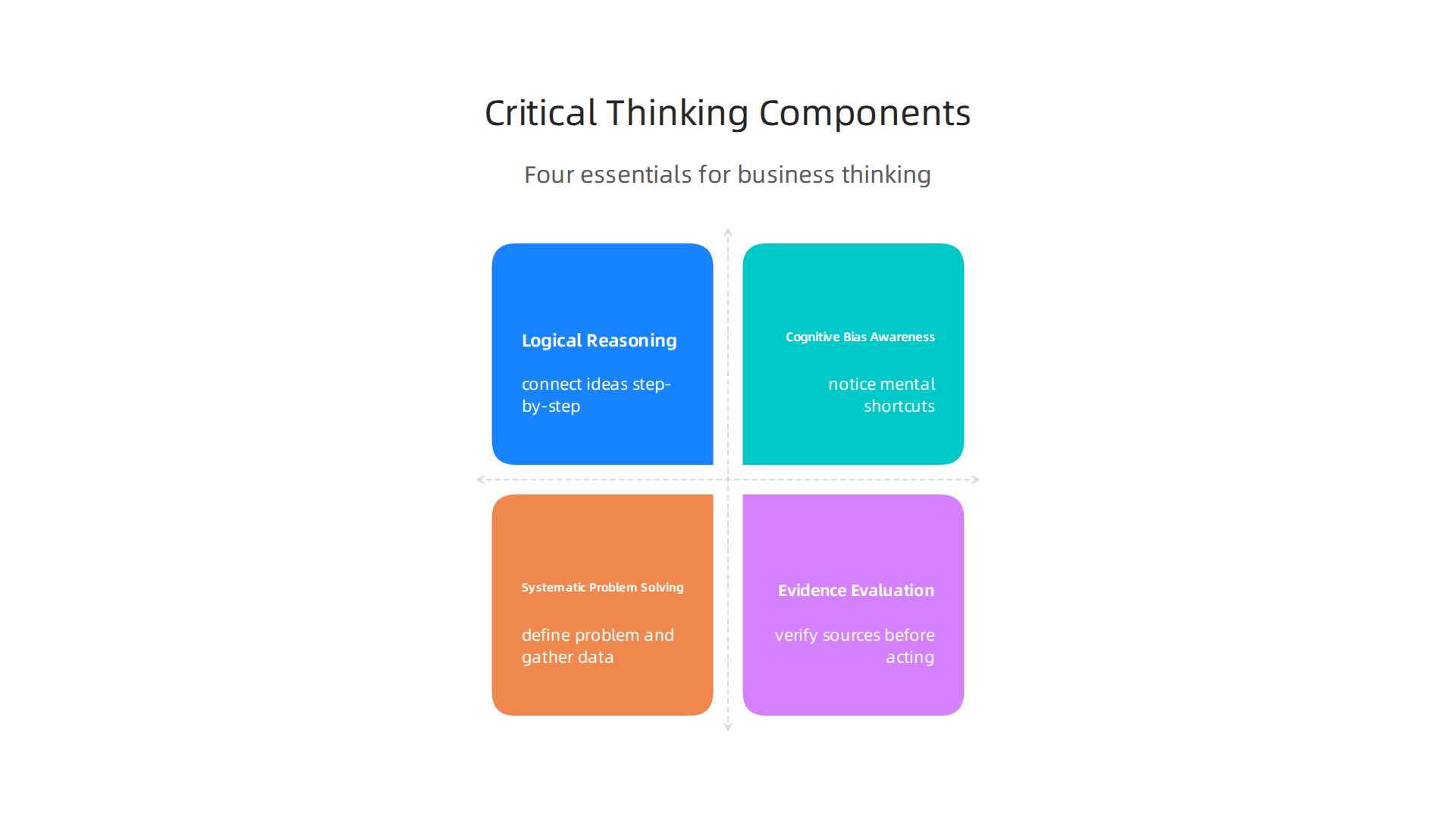
1. Logical reasoning. This is the ability to connect ideas in a step-by-step way. If A leads to B, and B leads to C, then what does that mean for your decision? Good leaders use logic to build sound arguments and spot weak ones.
2. Cognitive bias awareness. Your brain takes shortcuts. These shortcuts, called cognitive biases, can trick you into poor choices. For example, confirmation bias makes you favor information that supports what you already believe. A critical thinker notices when this is happening and steps back.
3. Systematic problem-solving. Instead of jumping to the first solution, you follow a method. You define the problem, gather data, list possible options, weigh the pros and cons, and then decide. This structured approach reduces errors.
4. Evidence evaluation. Not all data is equal. You need to ask: Where does this information come from? Is it recent? Is it complete? A critical thinker checks sources before acting on them.
The good news is that these four components are trainable. You can improve every one of them with practice and the right learning resources. And you do not need to go back to a classroom to do it.
To see how these skills apply directly to your career, read our guide on leadership and decision making framework. It walks you through a five-step process you can use starting today.
Understanding your own thinking patterns is only half the battle. The world around you also shapes how you think. External reward systems, feedback loops, and always-on digital environments constantly influence your judgment. If you want to go deeper on this topic, explore this Recognition Systems note. It examines how the systems around us can quietly steer our decision-making.
Critical thinking is not a mysterious gift reserved for a few. It is a learned skill that grows stronger with use. For anyone in business administration, it is the difference between reacting to problems and solving them before they grow.
The Business Case for Critical Thinking in Administration
That difference between reacting and solving has real dollar signs attached to it. Companies in 2026 are actively hunting for professionals who can think critically. It is not just a nice-to-have anymore.

It is a top priority for leadership development, directly impacting decision quality, risk management, and innovation.
According to a 2026 learning and development trends report, strategic and critical thinking is the #1 skill organizations want to build this year. The same report found that 77 percent of companies believe formal mentorship should be a must-do to scale these skills. When you improve your ability to think critically, you become the person others trust to solve hard problems. That trust leads to bigger projects, better roles, and more responsibility.
The financial return is also clear. A single manager with strong critical thinking can save or earn an organization an estimated $28,000 per year. That is according to an analysis of critical thinking ROI per manager. When you multiply that across a team or department, the numbers get huge. Training programs in critical thinking typically deliver 125 to 400 percent return on investment. Every dollar spent on upskilling your thinking pays back many times over.
Professionals with strong critical thinking also earn higher salaries and advance faster in their careers. If you work in business administration, you see this every day. The people who ask better questions and challenge assumptions get noticed. They get promoted. They lead teams. You can build these same critical thinking skills that boost your career through focused online learning, without leaving your current job.
Online learning pathways offer a low-risk way to develop this skill without interrupting your work schedule. You do not need to enroll in a full degree program or pay for expensive in-person workshops. Self-paced courses, video modules, and practical exercises let you train your mind at your own pace. Many resources are free or low-cost, making it accessible for anyone in business administration who wants to level up.
As you start strengthening your critical thinking, you will also become more aware of how external systems quietly shape your decisions. The digital world we live in is designed to influence us. Algorithms, notifications, and AI tools all push us in certain directions without us noticing. That is why being able to step back and evaluate information is more important than ever. This field note on how everyday users are silently shaped by two different AI systems gives you a real-world example of why these skills matter now.
The business case is simple. Critical thinking makes you a better decision maker. It makes you more valuable to your organization. And it increases your earning potential. The best part? You can start building it today with the right resources and a little bit of daily practice.
Top Online Learning Pathways to Build Critical Thinking Skills
So where do you start? The good news is you have more options than ever to build critical thinking skills without going back to school full time. In 2026, online learning pathways come in many shapes. Some are short and focused. Others are more in depth.
The right choice depends on your current role, your budget, and how much time you can set aside each week.
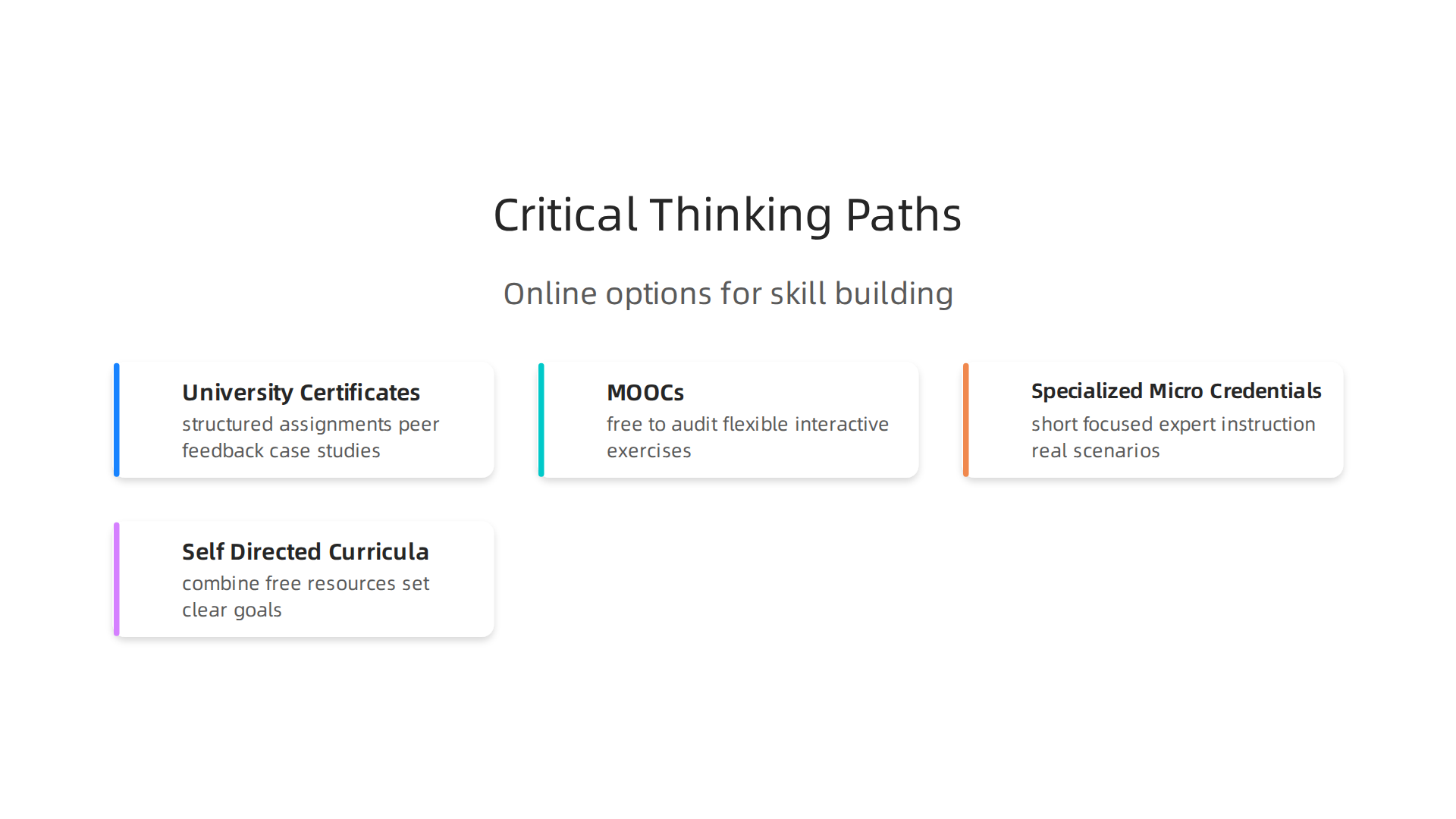
University Certificate Programs
Many top universities now offer dedicated critical thinking modules through their online platforms. These programs are often part of a larger business administration curriculum, but you can take them as standalone certificates. They tend to be more structured and include assignments, peer feedback, and real world case studies. For example, Purdue Global’s online bachelor’s degree in business administration includes coursework specifically designed to develop critical thinking and communication skills. You can find similar options at other accredited schools. The key is to look for programs that emphasize practical application over theory alone.
MOOCs from Platforms like Coursera and edX
Massive open online courses have become a go-to for busy professionals. Platforms like Coursera and edX offer dozens of critical thinking courses from leading universities.
Many are free to audit, and you can pay for a certificate if you want to add it to your resume. These courses let you learn at your own pace. Some even include interactive exercises that mimic real workplace problems. A good example is the 12 Best Online Critical Thinking Classes in 2026 list, which highlights options across multiple platforms. When you evaluate a MOOC, check the curriculum depth and instructor expertise. Look for courses that include opportunities to practice what you learn.
Specialized Micro Credentials
Micro credentials are short, focused programs that prove you have a specific skill. Companies like the American Management Association (AMA) offer critical thinking training courses online and in person. These are designed for working professionals who need to see results fast.
The AMA critical thinking training is a popular choice because it combines expert instruction with real scenarios. Micro credentials are also great if you want to show current or future employers that you actively invest in your development.
Self Directed Curricula
Maybe you prefer to build your own learning path. You can combine free resources from sites like HubSpot Academy or even use a Udemy login to access affordable courses on logic, problem solving, and decision making. The key is to be intentional. Pick topics that challenge you. Go beyond what you already know. And always ask yourself: How does this apply to the problems I face at work? Self directed learning works best when you set clear goals and stick to a schedule.
What to Look For in Any Program
No matter which pathway you choose, keep these filters in mind:
- Curriculum depth: Does the course cover more than surface level concepts? Does it teach you how to analyze assumptions, evaluate evidence, and draw sound conclusions?
- Instructor expertise: Who is teaching the course? Are they a recognized expert in critical thinking or business administration?
- Real world application: Can you immediately apply what you learn to your job? Look for case studies, simulations, or projects that mimic real business challenges.
Many top business schools now offer dedicated critical thinking modules online as part of their leadership development tracks. These modules often focus on strategic decision making, which is exactly what managers need in 2026.
A Quick Way to Get Started
If you want a ready made list of options, check out this guide on the top online certificate programs for critical thinking. It breaks down programs by cost, length, and focus area so you can compare easily.
And as you begin building these skills, remember that critical thinking is not just about solving problems. It is also about questioning the data that drives your decisions. In business administration, you often rely on reports, dashboards, and AI generated insights. The ability to evaluate the methodology behind that data is a huge advantage. A peer reviewed white paper on CRISP-DM and Skylab USA explains a permission based data capture methodology that can help you think more clearly about how information is collected and used. Understanding these frameworks makes you a sharper decision maker.
The pathway you choose matters less than the commitment to start. Pick one option, block out 30 minutes a day, and watch your thinking shift over the next few months.
How to Evaluate and Choose the Right Critical Thinking Program
Now that you know the different pathways, the next question is which one is right for you. With so many options in 2026, it is easy to get overwhelmed. Some programs look good on the surface but teach very little. Others are packed with valuable material but feel like homework. Here is a practical framework to help you cut through the noise and choose a program that actually moves the needle.
Look for Evidence Based Reasoning and Bias Training
The best critical thinking programs give you specific tools, not just encouragement. You want a course that teaches you how to evaluate evidence, spot cognitive biases, and use structured frameworks to solve problems. If a program mentions concepts like confirmation bias, anchoring, or the Dunning-Kruger effect, that is a good sign. If it only talks about generic problem solving without naming any bias, move on. For example, the Asana guide on critical thinking skills breaks down a 7 step process that includes analyzing evidence and reducing bias. Programs that cover bias are teaching you to think against your own mental shortcuts, which is exactly what business administration professionals need when making high stakes decisions.
Check the Instructor’s Credentials
Who teaches the course matters more than the price tag. Look for instructors with backgrounds in cognitive science, philosophy, behavioral economics, or business strategy. These fields study how people actually think and make mistakes. A course taught by someone with real experience in management, consulting, or executive education is usually more practical than one taught by a full time academic who has never worked outside a university. If you are looking for an accredited program, the leadership decision-making framework available on Critical Thinking Definition can help you understand what high quality instruction looks like. The instructor’s bio should include specific experience, not just a vague "over 20 years of teaching."
Prioritize Programs with Case Studies and Simulations
Nothing beats applying what you learn. The best programs include realistic case studies, simulations, or group projects that mimic the messy problems you face in business administration. You want to practice evaluating a budget, debating a strategic move, or analyzing a real company’s decision. Purely theoretical courses leave you with knowledge you never practice. Some platforms, like the top critical thinking training programs for 2025 highlighted by Sunsama, include hands on exercises that build real skills. When you look at a course, ask yourself: "Will I be doing something active, or just watching?" Active learning sticks.
Match the Program to Your Life
Even the best curriculum won’t help if you burn out or never finish. Consider your schedule and learning style. Do you have 30 minutes every morning? Or do you prefer weekend deep dives? Self paced courses work great for busy professionals in adult education. Some programs offer certificates that help you stand out when applying for remote jobs no experience because they prove you can think critically on your own. You can also find affordable options by using a Udemy login to grab micro courses on logic and fallacies. The key is to pick a format you can stick with.
Red Flags to Skip
Avoid programs that promise to "transform your brain" overnight. Other warning signs include instructors with no relevant background, zero mention of bias or reasoning, and courses that consist of only lectures with no practice exercises. A good program gives you tools, practice, and feedback. If you see vague outcomes like "become a better thinker," look for something more concrete.
A Final Thought on Digital Awareness
Many top programs now include content on how AI systems shape the information you see. Understanding this dynamic is a critical thinking skill in itself. If you want to go deeper, the Quietly Hijacked note explains how everyday users are silently shaped by two different AI systems they cannot see. Knowing how your own attention is influenced makes you a sharper decision maker in every area of business administration.
The right program is the one you finish and apply. Use these filters, take your time, and choose something that stretches you just enough.
Practical Strategies to Apply Critical Thinking Daily at Work
You finished a course and have the tools. But applying critical thinking at work every day is a different challenge. You get emails, meetings, deadlines, and pressure. It is easy to fall back into old habits. Here are three strategies that help you think sharper in real business scenarios.
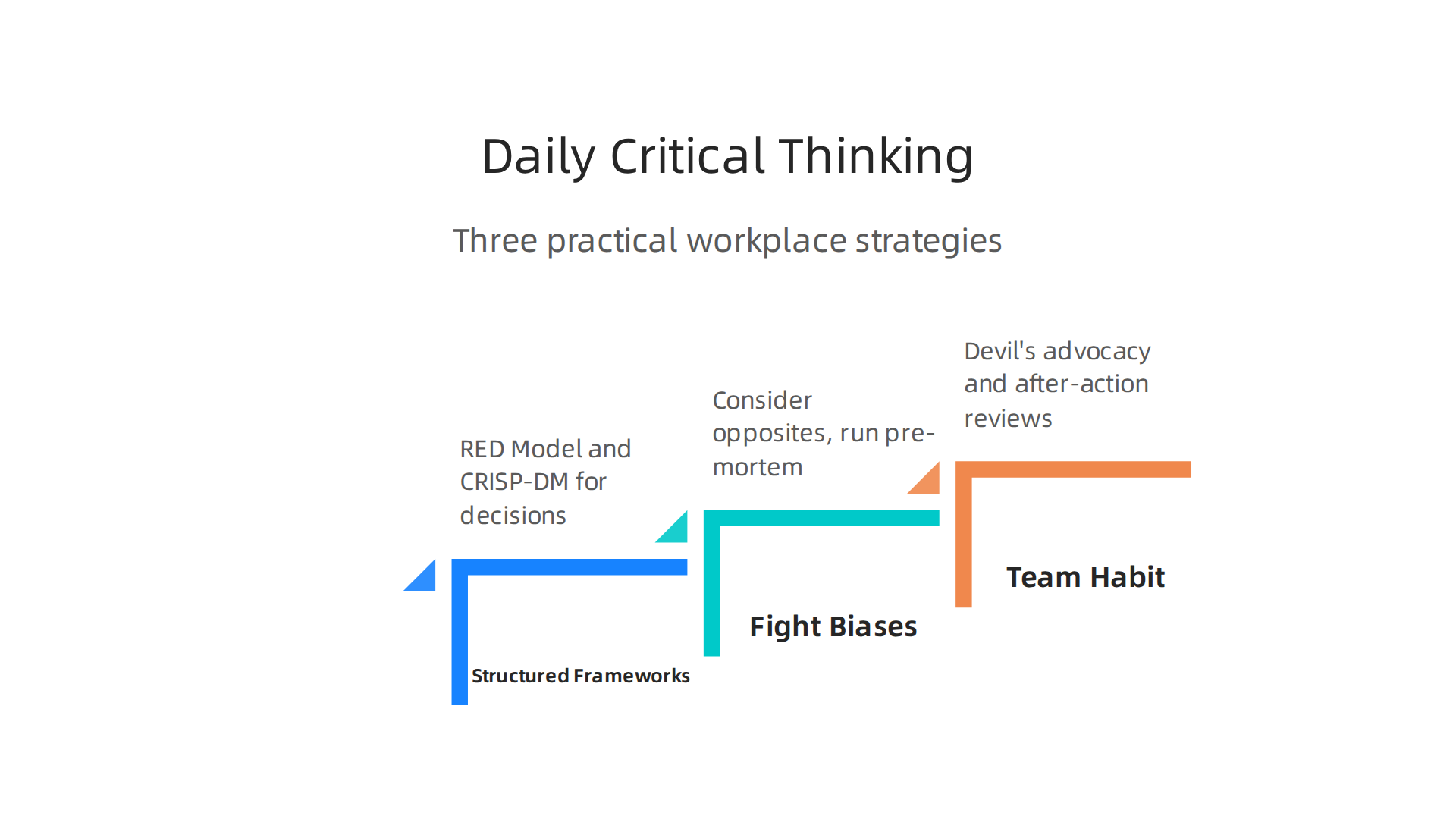
Use Structured Frameworks for Decisions
A framework turns a messy problem into a clear process. Two of the most useful ones are the RED Model and CRISP-DM.
The RED Model stands for Recognize, Evaluate, Draw. You recognize assumptions, evaluate evidence, and draw a conclusion. It works well for daily reasoning tasks like writing a report or deciding which vendor to hire.
CRISP-DM is designed for data driven decisions. It helps you move from understanding the business problem to deploying a solution. If you work with data in business administration, this framework keeps your analysis honest and repeatable.
A great place to deepen your understanding of these skills is through a resource focused on building critical thinking skills for business administration with online learning. It gives you a path to keep growing even after you finish your course.
Fight Your Own Biases Every Day
Even the best thinkers have blind spots. The trick is to build habits that catch them. Try these:
- Consider the opposite. Whenever you make a decision, write down one reason you could be wrong. This breaks the confidence trap.
- Run a pre-mortem. Before a project starts, imagine it failed six months from now. What went wrong? This helps you spot risks early.
- Track decisions. Keep a decision journal. Write down a choice, your reasoning, and what happened. Review it later to see patterns.
These techniques help you stay humble and accurate. Courses like those offered by the American Management Association teach these exact skills and can reinforce your practice.
Make Critical Thinking a Team Habit
Individual skills are powerful, but team norms multiply them. Push for practices that make critical thinking part of your company culture.
- Devil’s advocacy. Assign one person in every meeting to argue against the main proposal. This uncovers weak points.
- After-action reviews. After a project ends, ask what worked, what did not, and what you will change. Do not blame. Just learn.
- Questioning meetings. Schedule a 15 minute slot where anyone can challenge assumptions about current goals. Keep it safe and honest.
These norms turn critical thinking from a solo skill into a team strength.
Critical thinking starts with inner authority. Protecting your judgment means trusting your analysis while staying open to challenge. That balance is what makes a great business administrator.
Measuring Progress and Demonstrating Impact
You have learned the strategies and started applying them. But how do you know if your critical thinking is actually getting better? And how do you show that growth to your boss or future employer?
The answer is to measure your progress and build real evidence. This turns an abstract skill into something concrete that can help your career.
Use a Pre- and Post-Assessment
The best way to see if you are improving is to take a formal test before and after your learning journey. The most well known tool for this is the Watson-Glaser Critical Thinking Appraisal. It measures how well you analyze arguments, evaluate information, and draw conclusions.
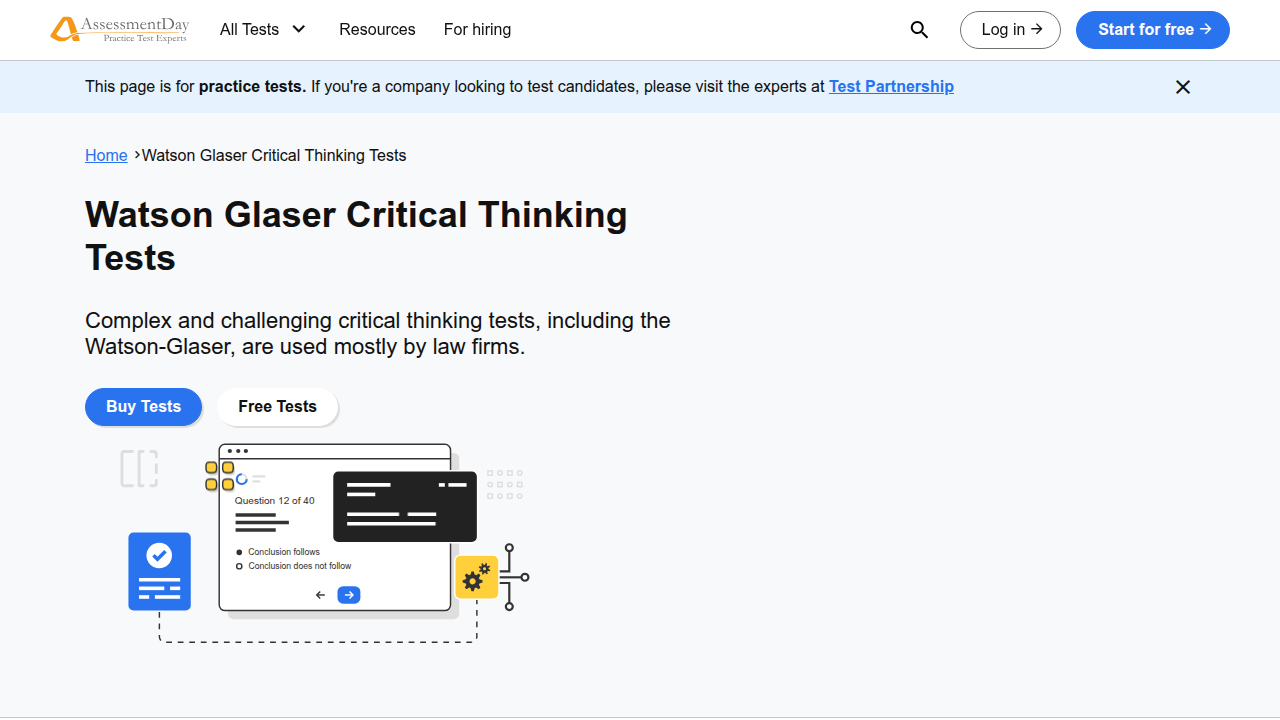
You can take a practice test to get a baseline score. Then after a few months of using the strategies we covered, take it again. A higher score shows real growth in your thinking ability. The test has been used for decades and is backed by research. You can explore a Watson Glaser Critical Thinking Tests to see what it looks like.
Using an assessment like this gives you an objective measure. It also shows employers that you take skill development seriously.
Build a Portfolio of Decisions
Numbers from a test are helpful. But real world results matter even more. Start a simple decision journal. For each important choice at work, write down:
- What problem you faced
- The options you considered
- Your reasoning and how you evaluated evidence
- The outcome, whether good or bad
Over time, this portfolio becomes a story of your growth. You can show it during performance reviews or job interviews. It proves you do not just talk about critical thinking, you practice it.
Many professionals in business administration find this habit useful because hiring managers in that field want proof of strong analytical skills. Courses that teach these techniques, like those from business management degree critical thinking skills resources, can show you how to structure your portfolio.
Share Tangible Evidence at Work
Employers value results they can see. Use your performance reviews to highlight projects where critical thinking made a difference. For example, maybe you used a structured framework to save money on a vendor contract. Or you ran a pre-mortem that caught a risk before it caused a delay.
Quantify your impact if possible. Saved dollars. Hours saved. Better team alignment. Write these down in simple terms.
When you demonstrate progress with real numbers and documented decisions, you become a stronger candidate for promotions and new roles. Your critical thinking skill becomes a clear career asset.
Critical thinking starts with inner authority. The more you measure your growth, the more confidence you build in your own judgment. To keep that momentum going, Protect Your Judgment by continuing to track your progress and staying open to honest feedback.
Summary
This article explains why critical thinking is the essential meta-skill for business administrators and shows how to build it using modern online learning. It defines practical components—logical reasoning, bias awareness, systematic problem solving, and evidence evaluation—and explains why those skills drive better decisions, reduce risk, and boost career outcomes. The guide compares learning pathways (university certificates, MOOCs, micro-credentials, and self-directed curricula), offers filters to choose high-quality programs, and recommends active learning elements like case studies and simulations. It also gives daily strategies—decision frameworks, bias-fighting techniques, and team norms—to apply lessons on the job, plus ways to measure progress with assessments and a decision portfolio. Readers will learn how to pick courses that fit their schedule, practice critical thinking consistently, and demonstrate measurable impact to employers.