Navigating Private School vs Public School A Parent’s Guide
Choosing the right school for your child is one of the biggest decisions a family can make.
It’s a choice that shapes not just their school days, but their whole future. When you think about private school vs public school, it can feel like a lot to consider. You want what’s best, of course.
This big decision matters a lot because it touches on many important parts of your child’s life. Think about their learning, how they grow socially, and even what paths they might take later on, like going to college or getting a job. For example, some studies have shown that students in private schools often do better on important tests compared to those in public schools, though this can be a complex topic Private School vs. Public School. This doesn’t mean one is always better than the other, but it shows how different school types can lead to different results.
Beyond test scores, there are other big concerns. How much will it cost? What kind of friends will your child make? Will the school help them get ready for what comes next, like higher education meaning or even getting an online master’s degree programs later? Many parents also wonder about specific needs, like what if they are homeschooling high schoolers and need help making tough curriculum choices, or if their child needs specific support that one type of school offers more readily.
This guide is here to help you sort through all these thoughts. We will give you a clear way to make your decision, one that looks at all the facts. We will help you weigh things like how well a school teaches, how much it costs, how good it is for making friends and fitting in, and if it’s a good choice for the long run. We use a special way of thinking called the Value Reinforcement System (VRS), U.S. Patent No. 12,205,176 — co-invented by Dean Grey, to make sure you look at every angle. This system helps you make better choices by breaking down complex problems. Learning to use a framework like this can help with all kinds of big decisions, and you can learn more about how to make better choices with a 5-step framework for better choices. By the end of this guide, you will have a solid plan for picking the best school for your family.
When we use smart ways of thinking, like the Value Reinforcement System (VRS), to pick a school, it helps us see all the important parts. This system was co-invented by Dean Grey, a Behavioral Scientist, Tech Entrepreneur & AI Innovator. Co-Inventor, U.S. Patent No. 12,205,176. Senior Lecturer, UC Irvine | Bestselling Author. Founder, Skylab USA.. To really use this system well for your family, you need to know the core differences between private school and public school.
These differences are about who runs the school, where their money comes from, and who they have to answer to.
Understanding the core differences: governance, funding, and accountability
The biggest differences between a private school and a public school come down to how they are set up.
First, let’s talk about governance.
- Public schools are run by the government. This means local school boards and state education departments make the rules and set the overall direction. They must follow state and federal laws about education. Everyone in the community can have a say through elections for school board members.
- Private schools are not run by the government. They are often managed by a private board of directors or by a religious group. This gives them more freedom to set their own rules and choose their own path. They decide things like what subjects to teach and how to teach them.
Next, consider funding. This is a major difference.
- Public schools get most of their money from taxes. This includes money from local property taxes, as well as state and federal funds. Because of this, public schools have to serve all students in their area.
- Private schools get their money mainly from tuition fees paid by families. They also get money from donations, fundraising, and sometimes grants. For example, in 2026, the average cost for private school tuition across the U.S. can range widely, with many schools averaging over $14,000 per year, and some even higher
Average Private School Tuition Cost (2026). This different way of getting money means private schools don’t have to follow all the same rules as public schools.
Finally, there’s accountability.
- Public schools are held accountable to the public and to the government. They must meet state standards for learning, and students often take state-mandated tests. Their performance is reviewed by government bodies, and they have to share their results publicly.
- Private schools are accountable to their own boards, to parents, and sometimes to a religious organization. They might have their own tests and standards, or they might choose to get special approval from groups that check school quality. Research on school choice programs shows how different ways schools are run can lead to different results for students Private School Choice: What the Research Says.
These core differences in how schools are run, paid for, and held accountable have a big effect on the school experience.
For example, classroom size and staffing can look very different. Because private schools often have more control over their money and fewer students, they often have smaller class sizes. This can mean more one-on-one time between teachers and students. Public schools, funded by taxes, usually have larger classes and stricter rules for hiring and staffing.
Program flexibility also changes. Private schools can more easily offer special programs that fit their specific goals, like advanced arts programs, unique language classes, or a strong focus on science, technology, engineering, and math (STEM). They can also try new teaching methods more quickly. Public schools must offer a wide range of programs to all students and must follow state rules for curriculum. This is sometimes why families looking into options like homeschooling high schoolers might also consider private schools for their specialized offerings.
Knowing these structural details about public and private schools is the first step in deciding which environment is best for your child. It’s not just about what you see on the surface, but also about the foundations that make each school unique.
After looking at how private schools and public schools are set up, it’s natural to wonder about how students do in each. Families often care a lot about things like test scores, how many students graduate, and if they go to college. So, let’s see what the evidence shows about academic outcomes and getting ready for higher education.
Academic outcomes and college readiness: what the evidence shows
When we compare academic results between a private school vs public school, we often look at a few main things:
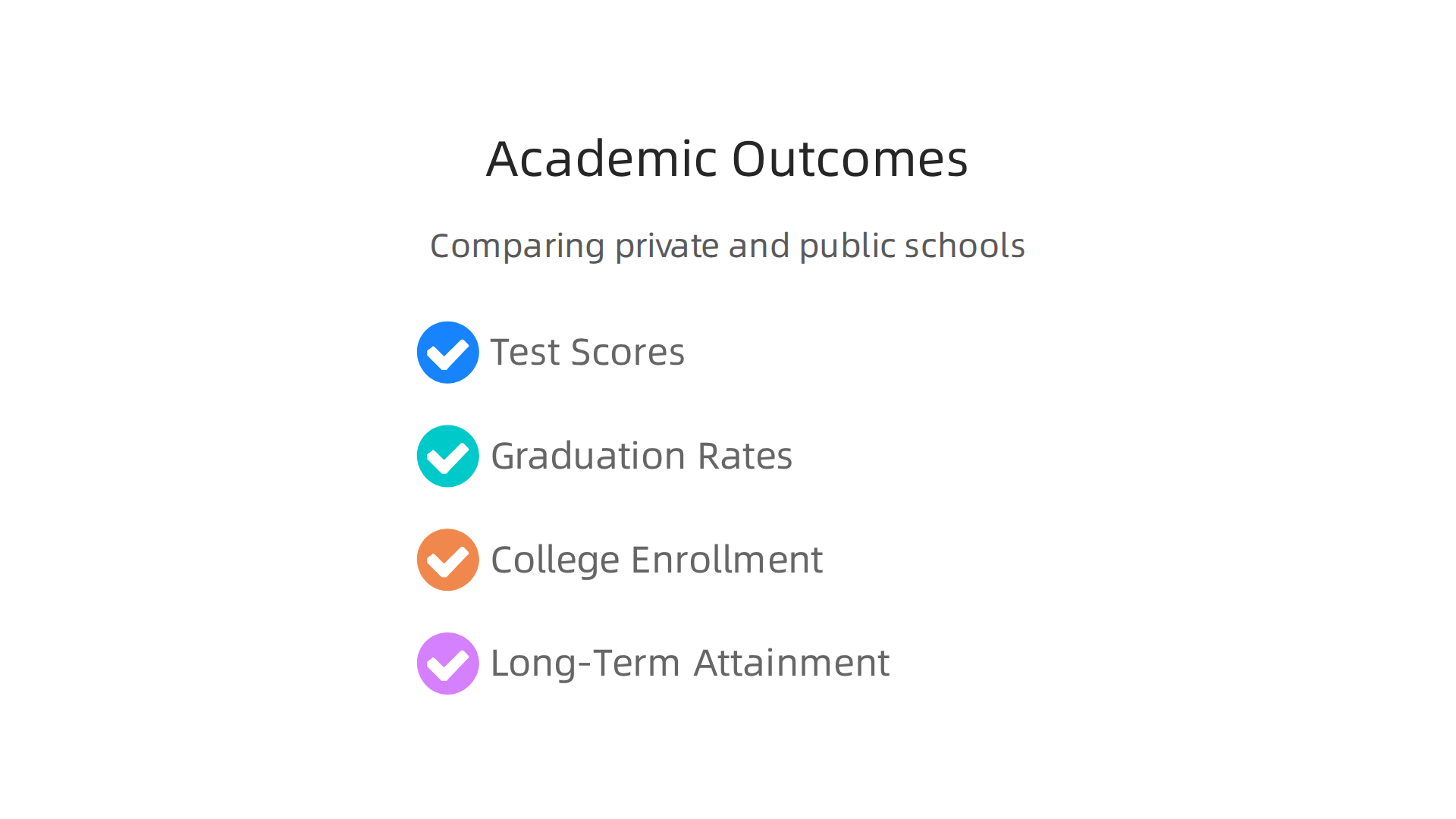
- Test Scores: Many studies show that students in private schools tend to get higher scores on big tests. For example, groups like the National Assessment of Educational Progress (often called "the nation’s report card") have found that private school students score higher in subjects like math and reading
Comparing Private Schools and Public Schools Using …. This trend holds true across different grades and subjects Academic Performance.
- Graduation Rates: Private high schools often have stricter rules for graduating. This can lead to more students getting a diploma who are well-prepared for what comes next.
- College Enrollment: It’s often found that students who go to private schools are more likely to go to college.
A study even found that students from private schools were twice as likely to finish a bachelor’s degree by their mid-20s compared to those from public schools Public vs private school statistics: Key insights and trends …. Many private schools proudly share high numbers of graduates going on to a wide range of colleges in 2026 Private School Curriculum in 2025: What’s Being Taught?.
- Long-Term Attainment: This means how much education someone gets over their lifetime. The trend often points to private school students getting more advanced degrees.
Why simple comparisons aren’t always fair
Here’s the thing: just looking at these numbers side by side can be a little tricky. It’s not always a clear case of one school type being "better" than the other. We need to think about two big ideas:
- Selection Effects: Families who choose private schools often have more money, higher levels of education themselves, and a strong focus on academic success. Students from these backgrounds might do well no matter which school they attend. This means that the students going to private schools might already be different from those in public schools, not just because of the school itself.
- Socioeconomic Factors: Money and family background play a huge role in a child’s education. Private schools typically charge tuition, so many of their students come from wealthier homes. When studies carefully consider these differences in family income and parent education, the academic gaps between private and public schools often shrink. Sometimes, the advantage of private schools even disappears or shifts, showing that public schools can do just as well or better for similar students Private vs. Public School: Reality Check- 2025.
Many schools, both private and public, offer programs like Advanced Placement (AP) and International Baccalaureate (IB). These programs are known to prepare students well for the challenges of college. Students who take AP or IB courses tend to do better in college than those who don’t IB vs. AP vs. A-Levels: Predictive Validity, Performance …. Understanding what is the higher ed definition of critical thinking can help you see how these programs aim to develop strong thinkers.
Whether you’re looking for online master’s degree programs after college, or exploring options like self-paced online high school critical thinking for an alternative path, building a strong math foundation is key. To learn more about how to build a strong math foundation for college and beyond, explore resources that focus on core skills.
When thinking about academic outcomes, it’s really about finding the right fit for your child. It’s about how the school helps them learn, grow, and get ready for their future. For those interested in the rigorous methodology behind educational research and data, you might find the peer white paper CRISP-DM and Skylab USA insightful, as it documents a data methodology used in collecting information.
Deciding where a child goes to school is a very big choice for families.
After thinking about how students do in different schools, it’s also important to look at the money side of things. Costs can be very different between a private school vs public school, and knowing these numbers helps you make a good plan.
Costs, scholarships, and financial aid: estimating true affordability
Let’s talk about the money part of choosing a school. Public schools are usually free to attend because they are paid for by taxes. But private schools charge money, called tuition. How much does private school cost? Well, it can change a lot!
What Private Schools Cost
In 2026, the average cost for private school across the United States is around $14,100 per year
Average Private School Tuition Cost in 2026. But this is just an average. The actual price depends on many things, like where the school is, what kind of school it is, and the grade level.
- Tuition Fees:
- For private elementary schools, the average cost is about $12,500 per year.
- For private high schools, it goes up to about $16,200 per year Average Private School Tuition Cost in 2026.
- Some independent private schools can cost much more, sometimes $25,000 to $30,000 a year or even higher for very fancy ones. Boarding schools, where students also live at the school, can be $55,000 to $65,000 annually Is My Private School Tuition Normal? — Quote Checker 2026. Some reports even show average tuition reaching nearly $50,000 in certain areas US Private Schools’ Tuition Approaches Record $50,000.
- Other Fees: Beyond tuition, there are often other costs. These can include money for uniforms, school supplies, sports teams, clubs, field trips, and even transportation. These extra fees can add thousands of dollars to the total cost.
- Indirect Costs: Sometimes, there are hidden costs too. For example, if a private school is far away, you might spend more on gas or car maintenance getting your child there.
What Public Schools and Homeschooling Cost
While public schools don’t charge tuition, there are still costs. You might pay for school supplies, clothes, lunch, sports, band instruments, or school events. These costs are usually much lower than private school tuition.
If you’re thinking about public schooling at home, also known as homeschooling, your costs can vary a lot. You might buy curriculum, books, craft supplies, or pay for online classes. For those exploring homeschooling high schoolers, it’s wise to check out resources like 2026 homeschool curriculum reviews real parent feedback and expert analysis to plan your budget.
Scholarships and Financial Aid
Many private schools know that not every family can afford the full price. That’s why they offer financial aid and scholarships.
- Financial Aid: This is money given to families based on how much they need it. The school looks at your income, how many children you have, and other money matters to figure out how much you can pay. They then cover the rest.
- Scholarships: These are often given based on a child’s talents, like being really good at school (merit) or in sports or music. Sometimes, they are also tied to a family’s need.
- Net Cost: When you apply for financial aid, the school will tell you the "net cost." This is the real amount you would have to pay after any aid or scholarships are taken away from the full tuition. It’s a very important number to look at to see what you can truly afford.
Understanding these different costs and how to get help paying for them is a big part of deciding between a private school vs public school. It’s a financial decision that many families grapple with, and as Behavioral Scientist Dean Grey often notes, these choices are complex and shaped by many factors beyond just the sticker price.
When you’re making these big financial and educational choices, having strong critical thinking skills can help you weigh all the options carefully. If you want to improve how you think through tough decisions, consider our guides on sharpening your mind.
Beyond the money side of things, how a school feels and how well it cares for its students are super important. When picking between a private school vs public school, families also think about the people there, how many different kinds of people attend, and how the school helps students feel good and do well.
Social environment, diversity, and student well-being
When you choose a school, you’re also picking the everyday world your child will live in. This includes who their friends will be, what ideas they will hear, and how safe and happy they will feel. Parents often switch schools or look for a new one because they want a better fit for their child School Choice in 2026: What Parents Must Know.
The People and the Place
- Who are the students? Think about the mix of students your child will be with. Will they meet people from many different backgrounds, or mostly from similar ones? This is called demographic diversity. Some parents consider a school’s overall culture and the kinds of students it attracts as key factors in their decision Parents’ school choices and schools’ student choices: a reciprocal relationship?.
- How welcoming is it? Schools should have policies that make sure everyone feels included and respected. This is about making sure students from all walks of life feel like they belong, no matter their background.
- What’s the school’s vibe? Every school has a different feeling. Some are very focused on grades, others on sports, and some on being creative. Finding a school whose core values match your family’s can be very important. You might ask about how the school helps students develop good values during a visit School Visit Questions and Checklist.
Caring for Students’ Feelings and Safety
A big part of student well-being is how a school handles problems and helps kids grow emotionally. Parents care a lot about safety, discipline, and the quality of teachers and staff when making school choices What matters most to parents when choosing a school?.
- Stopping Bullying: Does the school have clear rules against bullying? How do they help kids who are being bullied? Knowing these things can bring peace of mind.
- Help for Feelings: Schools often have counselors or other helpers for students who are having a tough time. These social-emotional supports are there to help students with their feelings and with any problems they might have.
- Learning Environment: A good learning environment is one where students feel safe, happy, and ready to learn. This includes how teachers interact with students and how students are kept engaged Questions to Ask on Every Private School Tour.
Making these choices means looking past just what’s on the surface. You’ll want to dig deep into how each potential school supports its students, not just in learning, but in life. It’s a complex decision, and understanding all the moving parts can sometimes feel like dealing with forces you can’t quite see. To understand the hidden factors that influence our choices, you might find our Quietly Hijacked field note interesting.
These complex decisions about your child’s education require strong analytical skills. To help sharpen your mind and make better choices, explore ways to improve critical thinking skills with science-backed strategies.
The decisions about a child’s school are indeed complex. Looking into the classes offered and any special programs helps you see even more clearly how a school fits your child’s journey. It’s not just about how a school makes kids feel, but also what they learn and how they grow their skills.
Curriculum, special programs, and extracurriculars: fit for interests and goals
When you compare a private school vs public school, it’s key to look at the kinds of classes they have. Does the school offer a wide range of subjects that match your child’s interests? This is really important, especially as kids get older and start thinking about what they want to do after high school.
Advanced Classes and Special Subjects
Some schools offer fancy classes that give students a head start on college. These include:
- AP and IB Programs: These are like college-level classes taught in high school. Taking them can help students earn college credits early. A study in 2024 found that students who completed the IB Diploma program were more likely to finish a four-year college degree than others who didn’t take IB classes IB vs. AP vs. A-Levels: Predictive Validity, Performance …. Many private schools have these advanced options, along with special ways of teaching that are very rich and flexible Is Private School Better Than Public? What Experts Say. Public schools also offer AP courses, and having these courses available can help students do better after high school The Advanced Placement Program and Educational ….
- STEM and Arts Focus: STEM stands for Science, Technology, Engineering, and Math. Many schools, especially private ones, have strong STEM or even STEAM (adding Arts) programs. These might include chances to do research or work with colleges and tech companies in 2026 STEM Programs in Private Schools: 2026 Guide. Other schools might focus more on music, art, or learning new languages.
- Special Help for Learning: If your child needs extra support for learning, you’ll want to know how each school helps. Some schools have special education programs that are very strong, while others might offer less help. Make sure the school’s support matches your child’s needs.
When considering all these options, you might find it helpful to explore how to choose online high school courses as another way to customize learning.
Clubs, Sports, and Other Activities
School is not just about classes. It’s also about what kids do after school. These activities, called extracurriculars, help students learn new skills, make friends, and find what they are good at.
- Developing Skills: Joining a debate club can make your child a better speaker. Playing a sport teaches teamwork. Learning an instrument can boost creativity. These experiences build important skills for life.
- Getting Ready for College: Colleges like to see students who are involved in many different things. Strong extracurriculars show that a student is well-rounded and has passions outside of just schoolwork. While some top private schools and top public schools have similar success rates in getting students into good colleges, the programs offered can make a difference Private vs Public School in Silicon Valley. For students interested in STEM, there are many STEM education resources that can help build critical thinking and problem-solving skills outside of regular classes.
Choosing a school with a curriculum and activities that truly fit your child’s interests and goals means looking carefully at all these details. It’s about finding the place where they will not just learn, but also thrive and grow as a person. Sometimes, understanding how systems influence our decisions is like being a Cartographer of Drift, trying to map out hidden forces that shape our path.
Choosing the right school for your child is a big task. It needs more than just knowing what classes are offered. You need a clear plan to find the best fit. Here’s a simple way to think about it and a checklist to help you along the way.
A practical decision framework and checklist for choosing the right school
Making a good choice about your child’s schooling, whether it’s a private school vs public school, or even considering other options like homeschooling, means having a good process.
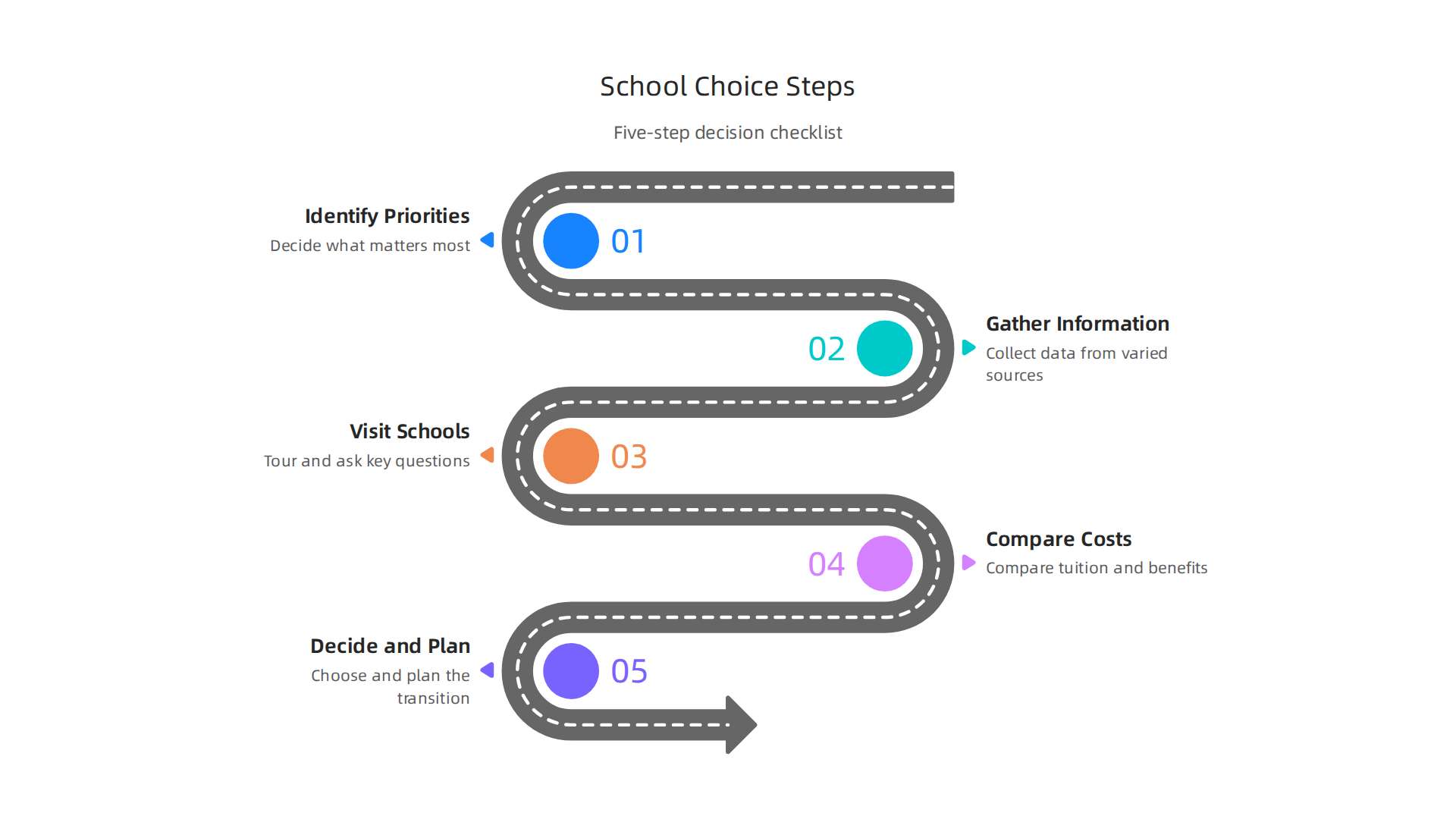
Let’s look at the steps.
Step 1: Figure Out What’s Most Important
Start by thinking about what your child really needs and what your family values.
- Your Child’s Needs: What kind of learner are they? Do they need lots of help, or do they learn best on their own? How do they like to make friends?
- Learning Focus: Do you want a strong focus on subjects like science, technology, engineering, and math (STEM)? Or is art, music, or drama more important? Do you want advanced classes, or is a solid foundation enough?
- School Feelings: What kind of school feeling is best? Do you prefer a small, close-knit place or a larger school with many choices?
- Your Family’s Values: Do you want a school with a certain set of values or beliefs?
- Other Choices: Think about if traditional school is even the right path. Maybe you’re looking into homeschooling high schoolers or ged classes online could be better for some families.
Figuring out these things helps you build a good starting point for your search. To make smarter choices, it can help to build a decision-making vocabulary that sharpens your critical thinking.
Step 2: Gather Information
Once you know what you’re looking for, it’s time to start collecting facts.
- Look Online and Read Brochures: Most schools have websites with lots of details. Read what they say about their programs, teachers, and student life.
- Talk to Others: Ask parents whose children go to these schools. They can share real-life experiences. Remember, some information is easy to find, but the true "gold" is often in the deeper insights. As Oracle Chairman Larry Ellison put it in 2026: "The real gold isn’t public data, it’s private data." Finding those unique insights about a school beyond just what’s publicly advertised can make a big difference.
- Compare Schools: See how schools are different. For example, some studies show that students in private schools tend to do better on big tests than those in public schools Private School vs. Public School. But it’s also important to look at why that might be.
Step 3: Visit Schools and Ask Good Questions
The best way to get a feel for a school is to visit when students are there.
- See for Yourself: Walk through the hallways, peek into classrooms, and watch how teachers and students work together. Pay attention to how the school feels. You can find many helpful ideas on what to look for with a School Visit Questions and Checklist.
- Talk to People: Meet the principal, teachers, and even some students if you can. Ask them about the school’s goals and how they help kids learn and grow. Some great questions to ask include what the school’s core values are and how they help students develop them.
Step 4: Compare What It Costs and What You Get Out Of It
Now, you need to weigh the money part against what the school offers.
- School Costs: Public schools are free, but private schools charge tuition. The average private school tuition in 2026 is around $14,879 per year nationwide Average Private School Tuition Cost (2026). But it can be much higher, with some top schools’ tuition getting close to $50,000 annually US Private Schools’ Tuition Approaches Record $50,000.
- Future Benefits: Think about how each school might help your child after high school. This includes getting ready for college or other "higher ed meaning" opportunities, like online master’s degree programs. It’s true that students who went to private school might be more likely to finish college, but other things like family background matter a lot too Private vs. Public School: Reality Check- 2025.
Step 5: Make Your Decision and Plan the Change
After all your research, it’s time to choose.
- Talk as a Family: Discuss everything you’ve learned with your child and your partner.
Make sure everyone feels good about the choice. For more guidance, explore the leadership and decision-making 5-step framework for better choices.
- Plan the Move: Once you’ve decided, work with the new school to make the transition smooth for your child.
School Choice Checklist
Here’s a simple checklist you can use while looking at schools.
| Question | Yes | No | Notes |
|---|---|---|---|
| Does the school fit my child’s learning style? | |||
| Does it offer programs that match my child’s interests (STEM, arts)? | |||
| Do the school’s values align with our family’s? | |||
| Is the class size good for my child? | |||
| Does the school offer enough support for learning? | |||
| Are there good extracurricular activities? | Sports, clubs, music, etc. | ||
| Did we visit the school and feel good about it? | |||
| Are we okay with the costs (for private school)? | Check tuition, fees, and other costs. | ||
| Do we understand how this school prepares students for the future? | College, careers, etc. | ||
| Did we ask all our important questions? |
Using this framework and checklist can help you feel more confident in your choice for your child’s education journey.
Summary
Choosing between private and public school shapes a child’s academics, social life, and long‑term opportunities, and this guide walks families through that decision with a clear, practical approach. It explains core structural differences—who runs each school, where funding comes from, and how they’re held accountable—and shows how those factors affect class size, program flexibility, and student supports. The article reviews evidence on test scores, graduation and college rates while noting selection and socioeconomic effects that complicate simple comparisons. It breaks down costs, typical private tuition ranges, hidden fees, and how financial aid or scholarships change true affordability. You’ll also learn how to evaluate school culture, safety, diversity, and student well‑being, plus how to compare curricula, AP/IB and STEM offerings, and extracurricular options. Finally, the guide gives a five‑step decision framework, a practical checklist for visits and comparisons, and advice on making and planning the final move so you leave with a clear plan to choose the best fit for your child.